Monday, April 10, 2017

A Zissen Peisach!

A Zissen Peisach!

  JEWISH NEWPORT: 
BLOG      FACEBOOK 


Shabbat was almost entirely a local affair at Touro Synagogue in Newport, RI. 

Among the visitors were Amir Sofer, his wife and children. Amir is the mayor of the Merom HaGalil Regional Council  מועצה אזורית מרום הגליל which was established in 1950. It covers an area of 69 square miles, and consists of 14 moshavim, one kibbutz, 8 communal settlements, a Druze village, and a Circassian village. The total population in 2014 was 14,600.  

By way of comparison, the Dokshitsy District in Belarus is 810 square miles, and has a population of about 30,000.

Moshav Meron is one of the communities in the district. There is a lot of action there on Lag BaOmer. The Zohar, which was attributed to Rabbi Shimon, said that Rabbi Shimon’s hillula (Yahrzeit) was on Lag BaOmer. Pilgrimages to the burial cave in Meron have been documented from the 12th century. Nowadays almost a million people make the pilgrimage on Lag BaOmer. It's Israel’s Woodstock!

As Rabbi Marc Mandel explained, the Haftarah spoke about the prophet Elijah, who traditionally visits all seders, 

“The Shabbat before Peisach is called Shabbat HaGadol, the Large Shabbat. Why is it called שבת הגדול?

'No one knows for sure. Some say it’s because of the last posuk of the special Haftarah,  Malachi 3:4 - 3:24

הִנֵּ֤ה אָֽנֹכִי֙ שֹׁלֵ֣חַ לָכֶ֔ם אֵ֖ת אֵלִיָּ֣ה הַנָּבִ֑יא  

‘Behold I will send you Elijah the prophet and he shall restore the hearts of the parents to the children and the hearts of the children to the parents.’  לִפְנֵ֗י בּ֚וֹא י֣וֹם יְהוָ֔ה הַגָּד֖וֹל וְהַנּוֹרָֽא 'before the great and awesome day.'

'Because the haftarah ends with the word גדול, some say it is called Shabbat Hagadol. 

"But it's fascinating that the theme of the haftarah ends with the relationship between parents and children and that one of the main themes of the holiday is
 וְהִגַּדְתָּ לְבִנְךָ, בַּיּוֹם הַהוּא, ‘And you shall tell your children about the story of Pesach.’


"When I was with my family for Purim, we discussed where our kids would be for Pesach, and when I said that my kids were working at Pesach programs, my sister  was surprised and said, ‘That's not what we do.’”

To the best of (limited) memory, Rabbi Mandel told us that helping other families celebrate the holiday was a worthwhile experience.

Jewish Newport wishes you all a zissin peisach, whether or not you are with your familiy, whether you are on the sea, on the land, on a plane, or on an island. Chag sameach!  
!חַג שָׂמֵחַ

Wednesday, March 29, 2017

I don’t need you anymore!

I don’t need you anymore!
at Touro Synagogue March 18, 2017
  JEWISH NEWPORT: BLOG FACEBOOK 


A few years ago, I stumbled on a help wanted ad, “Wanted, rabbi, expert in layning and leading, friendly, team player, likes island living.”  I always wondered what shul posted that ad.

In his words of Torah, Rabbi Marc Mandel opined about a congregational rabbi’s role,

“This Sunday, in New York City, Yeshiva University will be hosting its Chag HaSemikhah, which is a triennial graduation, celebrating the new rabbis ordained from 2015-2017: In this week’s Parsha, Parashat Ki Tisa, the challenges that a rabbi can face emerge and there are many insights about Rabbinic leadership.

“In a bizarre series of events, while Moshe is receiving the Torah at Mt. Sinai, his brother Aharon is somehow pressured into building the Golden Calf. God tells Moshe, ‘Go back down לֶךְ־רֵ֕ד, I don't need you anymore.’ God says to Moshe, ‘Your purpose as a rabbi was to be the spiritual leader of the Jewish people, but, now that they are worshiping a golden calf, what do I need you for? Go back down לֶךְ־רֵ֕ד, you’re fired!’

“What is the job of a rabbi in our modern times? Do rabbis have any influence over their communities? Or are they like Moshe and Aaron-who were helpless and couldn't prevent the people from fulfilling their desires and wishes to live their own lives?

“There are many challenges facing Jewish communities today. Recent surveys by the Pew Research Center indicate that the number of Jews who participate in Jewish community life is decreasing, and there are many questions about the Jewish future.

“What can a rabbi do to counter these powerful forces that are threatening the future of the Jewish people? Can rabbis prevent our communities from assimilating, or are we just like Moses and Aaron, participating in the building of modern idols that the people prefer? 

“The Parsha teaches us that Moses did not give up. True, he does smash the Ten Commandments. But he also got the Levites together, and they pledge their dedication  and commitment to follow the laws of the Torah. There was a plan for the future and Moshe went back up to Mt. Sinai and prepared for the next set of commandments.

“The broken commandments always traveled with the Jewish people as a reminder of that dark chapter and they remind us today, that we must rebuild our communities as we look forward to the future of strong and united Jewish communities.

“Rabbis cannot do this alone. Just as Moses worked with the Levites, rabbis and congregants must work together to build our communities and to plan the Jewish future together.”

In keeping with the theme that it takes a community, the parsha began with a census. God did not command that a census be taken, but just got right into the technical details, “When you take a census of the Israelite people according to their enrollment, each shall pay the LORD a ransom for himself on being enrolled, that no plague may come upon them through their being enrolled…the rich shall not pay more and the poor shall not pay less than half a shekel.” 

In this day and age, joining a community is voluntary. We are all equal, and we all need to work together for our island community to survive. An island is like a boat, and each member of the crew has a role to play to keep the ship afloat.

Shabbat Shalom

@jewishnewport @tourosynagoguenewport @newportri 


Tuesday, March 21, 2017

Mordechai, Esther, and Haman

Mordechai, Esther, and Haman
  Jewish Newport: Blog  Facebook


On Saturday, March 11, 2017, we observed Shabbat Zachor. Shabbat Zachor is one of two special Shabbats before Purim.  We take out two Torahs, read the maftir aliyah from the second Torah, and say a special haftarah. This year, It was also the day before Purim.

In the maftir, Deuteronomy 25:17-19, we are told, “Remember what Amalek did to you on your way our of Egypt…You shall erase the memory of Amalek from beneath the heavens, you shall not forget.” 

זָכ֕וֹר אֵ֛ת אֲשֶׁר־עָשָׂ֥ה לְךָ֖ עֲמָלֵ֑ק בַּדֶּ֖רֶךְ בְּצֵאתְכֶ֥ם מִמִּצְרָֽיִם׃… תִּמְחֶה֙ אֶת־זֵ֣כֶר עֲמָלֵ֔ק מִתַּ֖חַת הַשָּׁמָ֑יִם לֹ֖א תִּשְׁכָּֽח 

This meant the annihilation of the Amalekites; in the haftarah Samuel orders Saul to destroy the Amalekites without exception. In the Talmud, Haman is said to be an Amalekite.  

In his words of Torah, Rabbi Marc Mandel, of Touro Synagogue, Newport, RI, spoke about Esther. In his usual light hearted way, he related Purim to modern times,

“Many Jewish newspapers  and magazines do a special issue on Purim to celebrate the holiday. Something like a Purim spoof. When I lived in Los Angeles, the Jewish Journal used to do a special Purim issue every year. 

“Last year the issue had Donald Trump on the cover and the spoof was about President Donald Trump. Well, the joke’s on us because Donald Trump is now our president. 

“But the Purim story seems to live on! There seems to be one person in the White House who is positioned to act as a force of righteousness and a person who could help us as Jews. Like Esther this person is a woman, Ivanka Trump.

“Ivanka is a Jewish woman with sway over a non-Jewish family member in a position of power. Ivanka has championed some causes like climate change and paid maternity leave.

“But as the American Jewish community deals with increased anti-Semitism, Ivanka’s advocacy for the Jewish community is conspicuous by its total absence.

“But in all fairness to Ivanka, it is Jared Kushner, son of Holocaust survivors who should step up and accept Esther’s role.

“But neither Ivanka nor Jared has ever agreed to take this role. Esther did accept the role although at first she didn't want to and only did so because her Uncle Mordechai convinced her.

“So we are left to wonder, how will our modern day Purim story play itself out? We hope that our Purim story will have as happy an ending as the Book of Esther.

“Happy Purim!”

A few people had hoped that the Rabbi would discuss the command to "blot out the memory of the  Amalekites." Should we take this literally? And how can we take this literally? 

This is not a new issue. In the Talmud, Yoma 22b, Saul argued with God about  killing all the Amelikites, just as in Bereishit Abraham argued with God about destroying Sodom. “R`Mani said: ‘Because of what happens 'in the valley': When the Holy One, blessed be He, said to Saul: ‘Now go and smite Amalek,’( he[Saul] said: ‘If on account of one person the Torah said: Perform the ceremony of the heifer whose neck is to be broken, how much more [ought consideration to be given] to all these persons! And if human beings sinned, what has the cattle committed; and if the adults have sinned, what have the little ones done?’”

In Berakhot 28a, “Rabbi Yehoshua said to Rabban Gamliel: ‘Do Ammon and Moab reside in their place? Sennacherib already came and, through his policy of population transfer, scrambled all the nations.’” If the nations are scrambled, we can no longer tell who is an Amalekite,  and the command is void. (My Jewish Learning). The Rabbis had already decided to let the ancient text stand, so they did what they often did, found a loophole.  

Another approach is to say that Amalek represents a state of mind, or the evil inclination, not an ethnic group. Joseph Caro did not include the commandment to blot out the Amalek in his code of Jewish law, the Shulchan Aruch.

Sometimes people have identified the Amalekites of their day, be they Romans, Germans, etc. This is a slippery slope, and raises all the issues that the biblical command raises. 

Rabbi David Golinkin said, “In our day, perhaps the most important lesson is not hatred of Amalek but aversion to their actions.”

Golinkin’s grandfather, Rabbi Mordechai Golinkin, served in Zhitomir, Ukraine, Dokshitz, Danzig, and Worcester, Massachusetts and was on the Beth Din of the Vaad Harabonim of Massachusetts. 

Rabbi Mordechai Golinkin was zealous for his people during the time of a modern Haman. In 1942 he joined four hundred rabbis in a March of the Rabbis on Washington to persuade the United States government to do something about the Holocaust. At the White House, President Roosevelt left out the back door to avoid meeting them. 


The political fall out helped lead to the creation of the War Refugee Board. The Board and  the American Jewish Joint Distribution Committee sponsored Raul Wallenberg in 1944. Wallenberg saved the lives of thousands of Jews in Budapest, Hungary. The Rabbis never learned that their efforts helped to save lives.

Many are bothered that the command to blot out the Amalekites is in the Torah at all.  Torah is a big tent, including Tanach (bible), Talmud and all that follows. Although Judaism has preserved its earliest writings, it is much more.

sources:

David Golinkin, The Jeruslaem Post, March 9, 2006 THE FIRST WORD: ARE JEWS STILL COMMANDED TO BLOT OUT AMALEK?

MyJewishLearning.com  Ask the Expert: Blotting out Amalek How do we know who's an Amalekite?

Friday, March 10, 2017

Former Supreme Court Justice hears Touro Synagogue case

Former Supreme Court Justice hears case between Jeshuat Israel and Shearith Israel by Aaron Ginsburg


Touro rimonim at the Boston Museum of Fine Arts
photo by Aaron Ginsburg
The case between Congregations Jeshuat Israel, of Newport, RI and Shearith Israel of New York City over the fate of the eight million dollar rimonim, created by colonial silversmith Myer Myers, and control of Touro Synagogue must be an important one. A former United States Supreme Court Justice sits on the three judge First District Federal Appeals Court panel hearing the case.  

On Wednesday, March 8, several members of Jeshuat Israel went to Boston’s Seaport District to listen to oral arguments at the John Joseph Moakley United States Courthouse. Shearith Israel has appealed Rhode Island United States District Court Judge John J. McConnell, Jr.’s decision to award control of the rimonin and Touro Synagogue to Jeshuat Israel. 

The Jeshuat Israel members were led by co-presidents Dr. Naftali Sabo and Professor Louise Ellen Teitz, and by Rabbi Marc Mandel. Two Boston area members of the Touro Foundation, Shirley Saunders and Susan Goldberg, attended, as did Benyamin Yakovian, who visited Touro on Saturday. 

Member Marc Ladin drove up from South County. (There is no county named South County in Rhode Island. It refers to parts of Rhode Island on the west side of Narragansett Bay, south of Greater Providence.) Other attendees included Bea Ross, Bailey Siletchnik, Stephen Groskin, Gary Klein, Patti Weiss, Rhonda Sabo, and me.

I took the train from Sharon, Ma, to South Station. The walk along the waterfront included a great view of the Seaport District across the Fort Point Channel. After crossing Seaport Boulevard’s Evelyn Moakley Bridge, I arrived at the courthouse.

I was in such a rush that I didn't have a picture ID. Fortunately, I had a picture of my passport on one of my devices and after showing it and checking the devices, I was allowed through security. 

Once inside, we made our way to the courtroom in time to hear the first case. Our case was fourth on the docket. 

Each side in a case is allotted a set number of minutes, the appellant going first.  The appellant has the option of saving a few minutes for rebuttal. The three judges had read and discussed the briefs, and agreed on the questions they wanted answered. 

Soon after a lawyer began an oral argument, he or she would be interrupted by a question from Justice Sandra Lynch. Occasionally former United States Supreme Court Justice David Souter or visiting Judge Bobby R. Baldock asked for a clarification. Nowadays, Supreme Court Justices don’t usually retire, but soldier on until the very end.  David Souter retired in 2009 after 19 years on the Supreme Court and returned to his New Hampshire home. 

The attorneys have to be prepared to discuss every possible aspect of the case, not an easy task. If they waffled, they were admonished to get moving, or were told, “We’ve already discussed this,” or asked, "Do you really want to go there?" One young attorney smirked when she was listening to her opponent. Justice Lynch read her the riot act about proper behavior in court. I’m glad I was sitting in the back!

In our case each side had 20 minutes. Attorney Louis Solomon spoke for Shearith Israel. He argued that Shearith Israel’s obligation regarding Touro Synagogue was to the Jewish Community of Newport as a whole, rather than specifically to Congregation Jeshuat Israel. 

When Jeshuat Israel’s attorney, Gary Naftalis, spoke, the judges asked,”Didn’t the 1903 lease between Shearith Israel and Jeshuat Israel [for Jeshuat Israel’s rental of Touro Synagogue] supersede the previous history?” Hadn’t both parties agreed that Shearith Israel owned the Touro Synagogue building and everything that went with it?

Naftalis's response was twofold. He said, "You can't lend something that you don't own.” This may have applied to both the building and the rimonim. He also made the point that the lease was for the building...and the rimonim were not part of the building. Some discussion then ensued whether the rimonim were included in the lease.
Judge Lynch concluded by congratulating both lawyers on the high quality of their arguments, undoubtedly with the briefs in mind.

A lot of legal manpower is going into establishing whether Congregation Jeshuat Israel is congruent with the Jewish Community of Newport. Our minds were overflowing with the matter, and we needed to cool off.

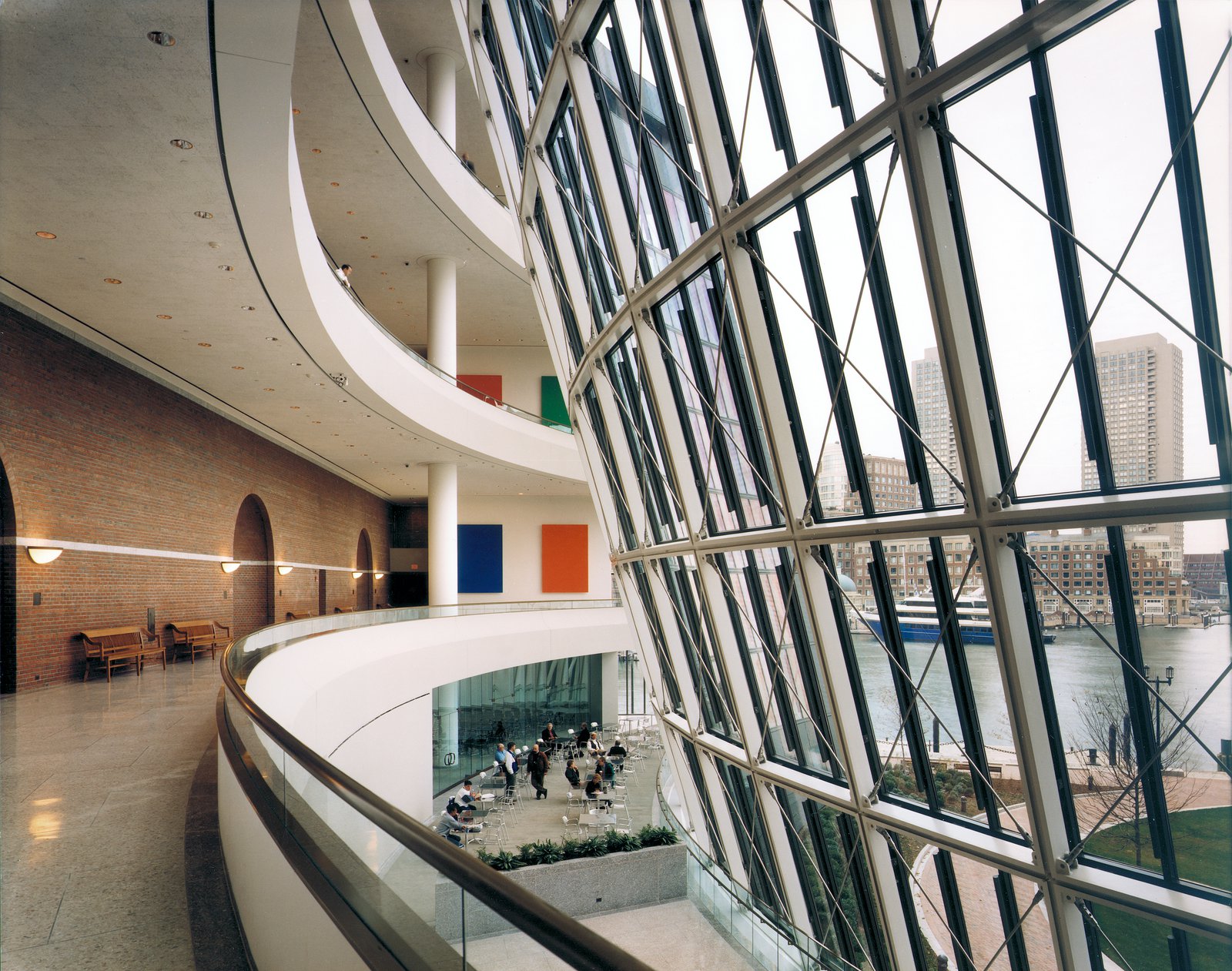
The view from the Moakley Courthouse. source: courthouse
 architects Pei Cobb Fried& Partners
Several of us decamped to the cafeteria for a light lunch. The cafeteria is one of the great bargains in downtown Boston. Not only is the cost of the food extremely reasonable, but the room’s massive windows provide a great view of downtown Boston. 

We then returned to our homes to anxiously await the court's decision, which may not be released for several months. Meanwhile Shabbat, Purim and Passover will provide some welcome respite.


Method Acting, Jewish Style

Method Acting, Jewish Style

At Touro Synagogue, March 4, 2017 By  AARON GINSBURG 

  JEWISH NEWPORT: BLOG  FACEBOOK

"Unless the theater can ennoble you, make you a better person, you should flee from it." Constantin Stanislavski  

Bama tova means both a good platform and a platform for good.  Bama also means stage. In Biblical Hebrew, bama בּמה means ‘high place.’ Bima בּימה, the platform in a synagogue, has a different origin, probably the Ancient Greek word bema, which means both ‘step’ and ‘platform.’ Source: Wikipedia. 

Bama Tova, founded by Benyamin Yakovian, promotes cross-cultural relationships to help people bridge the gaps between them. A Bama Tova in both senses, it is worthy of your support. 

Yakovian conceived of and directed the video, “Workers.”  In the video, he gives rides to Palestinian day workers in Israel. It is a very long day, which starts well before dawn and must end with their return to the Palestinian territory.

Benyamin Yakovian source: Bama Tova
Born in Iran, Benyamin Yakovian moved with his family to Israel as a child. He lives in Jerusalem. Currently at Harvard, he will soon return to Leipzig University to finish his doctorate.

Yakovian called Touro Synagogue to get details about services, and Rabbi Marc Mandel responded. It transpired that Yakovian was a cantor. Before you could say lickety-split, Hazan Yakovian agreed to lead ma'ariv on Friday, mussaf on Saturday, and lain two aliyot. 

Dr. James Herstoff stepped onto an irregular curb walking on Touro Street Saturday morning before services, and twisted his foot as he fell into the street. Rabbi Mandel fetched some ice, which was applied in shul. After the ankle started swelling,  Dr Herstoff prudently went home. Pesukei dezimrot and shacharit were added to Hazan Yakovian’s list. 

Sunday, Dr. Herstoff went to the doctor. He had broken a fibula, and got the boot, which he will be wearing for six weeks. We look forward to his speedy recovery and his return to Touro Synagogue. Meanwhile, he has authorized me to have an extra schnapps on Saturday.

Yakovian davened in the Sephardic style. His voice resonated with piety and sincerity, and was bigger than the room. Listening to him was an inspiring experience that brought me to tears. With his help our prayers mingled together, piercing each other's hearts as they hopefully rose even higher. 

Rabbi Mandel discussed the building of Touro Synagogue, 

"Since our synagogue, the Touro Synagogue, is the oldest synagogue building in the United States, there are many mysteries connected to the structure. One of the mysteries is, how did the architect Peter Harrison know how to design this synagogue? Harrison wasn't Jewish. How did he know what a synagogue looked like? He could have use this morning's torah reading as a blueprint for what a synagogue should look like.

"This morning's parsha, Parashat Terumah (Exodus 25:1 - 27:19)/ פרשת תרומה, discusses the architecture and design of a synagogue – and it is summed up in the passage God says, 'make for me a sanctuary and I shall dwell among you.
(Shemot 25:8עָ֥שׂוּ לִ֖י מִקְדָּ֑שׁ וְשָׁכַנְתִּ֖י בְּתוֹכָֽם ׃)’ Wherever Jews have lived they have built synagogues. It was no different in Newport. 

"But the question remains, how did architect Peter Harrison know how to design Touro synagogue? Had he seen the Mikveh Israel Synagogue in Curaçao, which was constructed in 1703? Our member Saul Woythaler recently visited that synagogue. Saul – does it look like Touro Synagogue?[Saul said, 'Yes.'] Or had he seen Shearith Israel's Mill Street Synagogue in New York, which was dedicated in 1739? Or perhaps it was Hazan Isaac Touro, who shared his knowledge of the Spanish and Portuguese synagogue in Amsterdam?

"We have to remember that the Jewish community in Newport spent a century without a dedicated place of worship. Synagogues, in the 13 British colonies, were rare before the American revolution. 

"By the late 1750s, the Newport Jewish community had the financial means to begin construction of this synagogue. It was a mark of the integration of the Jewish community into the mainstream of American life that they secured the collaboration of a leading American architect. But Peter Harrison was knowledgeable about Christian houses of worship and he needed Isaac Touro's advice about the requirements of Jewish law. It's quite possible that Isaac Touro used this week's Torah reading as his guide. 

"The final result is a fusion of different traditions and stands as an early example of the adaptive melting pot of styles and ideas that characterizes American architecture.

“Shabbat Shalom!”

A synagogue is a bama, a platform or stage for the community to commune with each other and with G-d. Services are a type of play. The audience, both our fellows and the one above, is demanding; we hope for a review that is both just and merciful. 

Constatin Stanislavski, the Russian actor, director and teacher, thought deeply about the theater. To enable actors to understand and portray characters realistically, the Stanislavski method acting system uses actions and situations to activate actors’ emotions. The Jewish method of acting uses the synagogue’s design, the service, and the hazzanut. With G-d’s help, our system enables us to pray with all our hearts, with all our souls, and with all our might.

@tourosynagoguenewport

Monday, February 27, 2017

At Touro Synagogue, February 25, 2017

At Touro Synagogue, February 25, 2017
The big and the small of it; the Rabbi and Dr. J

Rabbi Marc and Jackie Mandel were back in Newport after their brief sojourn in Detroit. They had the special glow that new grandparents have.

Rabbi Mandel spoke with his customary brevity and flare, starting with an incident from the trip to Detroit. He segued to a short but tantalizing discussion about a big subject, the nature of the laws we live by.

"Shabbat Shalom

"Jackie and I are glad to be back in Newport and we thank the Congregation for all the wishes of mazel tov on our new grandson. Last week Jackie and I drove to our grandson’s bris in Detroit; our GPS took us through Canada. We didn't realize this in advance, and we didn’t have our passports. So we were stuck in the immigration office at the border for about an hour. 

"We were in the hands of gun-toting officials who went about their routine. Jackie produced a key piece of evidence-a picture of our grandson, Abie, on her cell phone. Tired after a full day on the road, we anxiously awaited their decision. Finally, we received permission to enter Canada.

"Of course every country has laws about entering their territory. These are very common laws similar to the type of laws we read about in this week’s Parsha, Parashat Mishpatim. Mishpatim means laws. Every society and every country has laws. Not all laws are good. The Nazis had the Nuremberg Laws, which excluded the Jews from all German life; these were horrible laws for the Jewish people.

"What is the most famous law in this week's Parsha?

"I believe it would be, ‘an eye for an eye, a tooth for a tooth’  (עַיִן בְּעַיִן שֵׁן בְּשֵׁן) This passage in the Torah has often been misunderstood."

I thought that the Rabbi might mention Shakespeare's play, The Merchant of Venice. Sure enough, he did. In the play, the Jew, Shylock, demands that a pound of flesh secure a loan to a Christian. 

Rabbi Mandel continued, "The Talmud explains that the Torah never meant to take a person’s limbs if they harmed someone. The law is that you are compensated financially if you are injured."
Was Shakespeare being Talmudic in The Merchant of Venice? Shakespeare was a master a punning and double entendres. On the one hand, Shylock is a stock figure, a stereotype, but on the other hand, he rises above the stereotype.  Although he is bitter, he is also noble and proud.

[From The Merchant of Venice:

SALARINO
Why, I am sure, if he forfeit, thou wilt not take
his flesh: what's that good for?

SHYLOCK
To bait fish withal: if it will feed nothing else, it will feed my revenge. 

He hath disgraced me, and hindered me half a million; laughed at my losses, mocked at my gains, scorned my nation, thwarted my bargains, cooled my friends, heated mine
enemies; and what's his reason? I am a Jew. Hath not a Jew eyes? hath not a Jew hands, organs, dimensions, senses, affections, passions? fed with the same food, hurt with the same weapons, subject to the same diseases, healed by the same means, warmed and cooled by the same winter and summer, as a Christian is? If you prick us, do we not bleed? if you tickle us, do we not laugh? if you poison us, do we not die? and if you wrong us, shall we not revenge? 

If we are like you in the rest, we will resemble you in that. If a Jew wrong a Christian,
what is his humility? Revenge. If a Christian wrong a Jew, what should his sufferance be by Christian example? Why, revenge. The villany you teach me, I will execute, and it shall go hard but I will better the instruction.]

Rabbi Mandel continued, ”The  Rabbis in the Talmud explained that you can’t interpret this passage according to its literal meaning. They had license to reinterpret the meaning of the passage. The Talmud explains that the Torah mandates a sophisticated, five part monetary form of compensation consisting of payment for damages, pain, medical expenses, incapacitation, and mental anguish.

"Laws, to be respected, need to respect all people.

"Shabbat shalom!"

Visiting from Manhattan were Jamie and Dena Small. Dena grew up in Detroit. She was very familiar with the Detroit scene and the places the Mandels saw during their visit. Jamie's parents are David B. and Sandy Kline Small, so Kline married Small-and their son, Jamie, is not tall!  

David Small shaking the hand of Dr J,
Marc Mandel is standing behind 
David,
It's a small Jewish world. Rabbi Mandel realized that he knew Jamie's father, David B. Small. Marc Mandel and David B. Small both grew up in Far Rockaway, NY, and went to Camp Hocus Pocus together… no, make that Camp Tagola. 

Pictured is David Small shaking the hand of  Julius Erving, commonly referred to as Dr. J. Marc Mandel is standing behind his friend, David.

Dr. J is one of basketball's greats. He is well known for the slam dunk, which he combined with other moves into an art form. He dropped out of the University of Massachusetts Amherst in 1971 to join the American Basketball Association, but made a point of completing his education in 1986 to fulfill a promise to his mother through the UMASS University Without Walls program.

In 2008, Dr J. visited Israel with fellow star Rick Barry in support of the Migdal Or youth village for underprivileged children. He told Israel's president, Shimon Peres, "I am truly inspired to be an ambassador for the country and for the village."

Dena Small, a student of literature, is a lover of books. When Rabbi Mandel mentioned that the name of the protagonist, David Small, in the book by Harry Kemelman, z.l.,  Friday The Rabbi Slept Late, had the same as her father-in-law, she was delighted. We then learned what rabbis like to collect: rabbinical books. Rabbi Mandel pulled five books of the When the Rabbi Slept series from his bookshelf.

Author Harry Kemelman lived in an old New England port not dissimilar to Newport, Marblehead, MA, and was friendly with his rabbi. Every rabbi should have his Kemelman. Rabbi Mandel, you are on notice!


Any way you slice it, it's a small world. read more from Jewish Newport  on the web or on facebook contact me

Thursday, February 23, 2017

At Touro Synagogue February 18, 2017

At Touro Synagogue February 18, 2017

I don’t get no respect!


On Shabbat Rabbi Marc Mandel and his wife Jackie were in Detroit kvelling over their newborn grandson. But we were in good hands. Dr. Jim Herstoff led P’sukei D’zimra and Shacharit, Sam Spencer leyned Torah and delivered the sermon, and Carmi Mandel led the balance of the service. There was a minor tiff when someone thought their usual seat was occupied, but the offender gracefully said, “I’ve been saving this seat for you!” Order was soon restored.

We read Parashat Yitro, Exodus 18:1 - 20:23, one of the Torah’s the shortest parshiot. In a burst of optimism Rabbi Mandel tried to recruit yours truly; in a burst of realism Sam Spencer got the job. Co-president Dr. Naftali Sabo pointed out that Sam had the accent on the last syllable, in the Sephardic fashion. 

There was a lot doing in the Parsha. At the beginning, Moshe’s father-in-law, Jethro, cautioned Moses against overextending himself and advised him to delegate some of the work. Moshe followed the advice. Nowadays, I wonder how many men accept a suggestion from a father-in-law, should one be courageous enough to tender some  advice.  

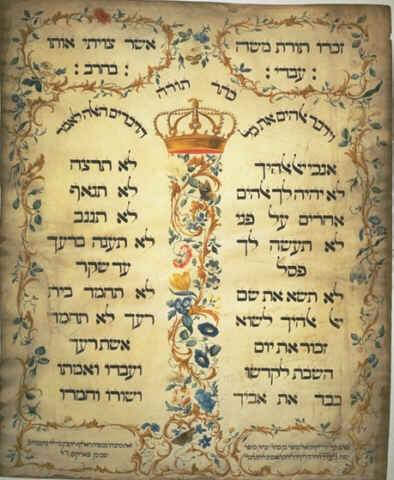
Decalogue Parchment
Yuketiel Sofer 1768
The highlight of the Parsha was the ten commandments, Asereth ha-D'bharîm עשרת הדברים, literally the ten words. The moniker “ten commandments” is a recent, and not a Jewish, innovation.  Sam mentioned the division of the commandments between the first five, which are between God and man, and the second five, which are between man and man. 


The fifth commandment, “Honor thy father and thy mother,” seems like it is out of place. Sam told us that the commandment teaches two important lessons, that there is something more important than ourselves, and that we did not come out of nowhere. He also said that honoring God and honoring our parents are connected, and that this honor should be extended to all, since we are created by and in the image of God. 

This is very much in tune with Jewish tradition, which extends the honor to step-parents and others that raise us, including siblings, grandparents and others, whether they are related or not, and to our teachers. 

Honor has its limits, and we are not expected to break a commandment at our parents request, nor to marry or not marry someone at their request.

In Judaism, honor is a two way street, and parents are expected to honor the children who honor them. 

I know you’ve been wondering, so I have the name of Rabbi and Jackie Mandel’s grandson from a reliable source, “His English name is Abie and his Hebrew name is Noam Avraham. He is named after Rabbi Mandel's father who was Avraham and after his father Yaakov's grandfather who was also Avraham.” 

Shabbat Shalom! read more from Jewish Newport  on the web or on facebook contact me


read more about the decalogue  or  the fifth commandment  on wikipedia