Thursday, March 7, 2019

Keep Your Eye on the Ball

Keep Your Eye on the Ball

At Touro Synagogue February 23, 2019

also on facebook


After three weeks of sermons about the Super Bowl I think it’s time for a change. Baseball season is not far away.


Flying from Tel Aviv to Boston made for a long day. After just a few hours of sleep, I woke up at 5::45 AM on February 22 and drove from Jerusalem to Ben Gurion Airport. I was tired and circled in the large airport three times before I found the Hertz rental car return.  My flight left at 10:30 AM for Istanbul. My final flight landed in Boston at 5:59 PM. I took Logan Express to Braintree, and arrived at my Foxboro home at 7:47 PM. That adds up to 10 hours, to which 7 hours should be added to account for the time difference.


My trip was very successful. It took a week to recover from the exhaustion and to reset my clock. At the beginning I was having supper at 4 PM, and waking up the next day at 2 or 3 AM.


The day after I arrived I went to services at Touro Synagogue. I was a little bit late, and before I could sit down I was called to the bimah for an aliyah.


Rabbi Marc Mandel said,


“In our society we are very much focussed on being successful. We send our children to school at a young age - we want them to go to a good college and have good careers.


“We are all focused on success. What happens when there is failure? Do we know how to cope with failure?


“Success and failure is at the heart of this week’s parsha, Ki Tisa(Hebrew). The Jewish nation was successful. They witnessed the ten plagues, the splitting of the Red Sea. They received the torah at Mt. Sinai. People from all over the globe were attracted to Judaism. They were a successful people.


“Then came failure and the sin of the golden calf. A great nation falling for the fatal attraction of the golden calf! Entire families were swept up in this huge mistake. Even Moshe’s family wasn't spared - his brother Aharon participated in this event. What happened?


“Rabbi Shay Schechter explains that the Jews became distracted. They weren't really focused on God. It’s so hard to stay focused - especially today when we are all distracted by the technology that is all around us. Cellphones, e-mail, text messages, facebook, youtube, Netflix, twitter, instagram - how can anyone stay focused today? It’s impossible.


“That’s what happened to the Jewish people. They couldn't stay focused. Rabbi Schechter quotes the posuk from Shir Hashirim 4;9, לִבַּבְתִּנִי באחד (בְּאַחַת) מֵעֵינַיִךְ, “I loved you with one of my eyes.” What does that mean, “With one of your eyes?” The midrash says that while the Jews were receiving the torah, they had one eye on the golden calf. They were distracted by the glitter of the golden calf.


“This is the challenge we all have, to not be distracted from our main tasks.


“Shabbat Shalom”


Being easily distracted can sometimes be helpful. Our lives our insecure. We need to be alert to distractions because something important might be happening. It’s when the distractions take over that we can run into a problem.


When I am trying to accomplish something, I find that I constantly succumb to a distraction…the latest news and weather, e-mail, facebook, tuning into the background music, crossword puzzles (I prefer the New York Times Monday puzzle, which I can usually complete without getting everything right). And then there is the refrigerator. How much more might I accomplish if I kept my eye on the ball.


May you keep your eyes on the ball without being overly distracted.


Shabbat Shalom from Jewish Newport!


Thank you to Rabbi Mandel for sharing his words of torah and to Beth Ginsburg Levine for editing.

Friday, March 1, 2019

Newport and Jerusalem

Newport and Jerusalem

At Touro Synagogue February 16, 2019  

By  AARON GINSBURG                                                                                                    

ALSO ON FACEBOOK


On Friday evening February 15, I had the honor of spending Shabbat in Jerusalem with Benyamin Yakovian, his father and brother. When Benyamin visited Touro Synagogue, we enjoyed his davening immensely. His voice and his ruach filled the shul

In Newport, the Super Bowl was very much on people's minds. Rabbi Marc Mandel of Touro Synagogue said,

“A few weeks ago, in my sermon, I posed and answered, ‘What made the New England Patriots so successful? Perhaps the answer is their great teamwork.” After that sermon, Saul Woythaler said to me, ‘Perhaps the secret of the success of the New England Patriots is their coach. They have a great coach, just like Moshe was a great coach for the Jewish people.’

“There is no question that Bill Belichick is a superb coach and that he has helped the Patriots become a great team, and there is no question that Moshe was a great coach for the Jewish people and he helped them become a great nation.

“…As we say in Yigdal, there was never another Prophet like Moshe. Still, his siblings Aaron and Miriam were angry at him and wanted to know why he thought he was so special when they too were prophets. But God said there is a difference between you and your brother, because he has abilities that no Prophet ever had or will ever have again. Moshe could see things that no other Prophet could see, and perhaps Bill Belichick is a coach that can also see things that no one else can see.  

“It's hard to find a great leader and this is a challenge that we all face in our times. Let us hope and pray that we will find great leaders like Bill Belichick and Moshe.”

I went to the masorti Congregation Moreshet Avraham, just a few blocks away from where I was staying with Moshe Bar Zev and Carol Fuchs. Why this congregation? I was confident that I would know people, and Carol mentioned that there would be a Kiddish.

I felt very much at home. I was made to feel welcome, just as visitors are welcomed at Touro Synagogue by the officers, the rabbi, and congregants. Soon the president of the congregation Alexis Silverman greeted me. Shortly after that Rabbi Yosef Kleiner said hello. This is something that a leader needs to do to set the tone, be they a president or a rabbi. Soon I was asked to lift the Torah. Fortunately, I have had plenty of practice at Touro Synagogue!

Jac and Diane Friedgut arrived. Diane was born in Fall River, as was my mother. I was invited to join them and gladly did. It was nice to meet some of their family. One of their daughters is a newscaster for JBS and summarizes the news from Israel. Jac listens to the news hourly in case something happens before it gets on the newswire, and confers with his daughter to keep her up to date. Diane has been active with Masorti Women's Study Day for many years.

Rabbi Kleiner spoke began his talk about fashion, but in fact it was about respect and leadership,

“Why does the Torah take so much care about the garments of the cohanim, of the priests? Is it so crucial that they be dressed in so a special way?
“Moreover, some chapters before this parashah, God says explicitly that all the People of Israel is to be a kingdom of priests. So what is the point of stating this flagrant difference among the people, dressing some of them in garments that are made for "honor and splendor"?
“Nachmanides (Ex. 28:2) explains that the honor and the splendor aren't those of the cohen, the priest himself, but through his special presence, dressed in a wonderful manner, we grasp the honor and holiness of God and it makes us, the people, be in splendor. The wonderful sight of the cohanim is not for their own sake, but to influence our feelings.
“These details about the garments and all the special procedure followed in the Tabernacle, and later in the Temple, have also another goal. God says there that through this special sanctity of the priestly function and of the Temple, He will dwell in the midst of the People of Israel (id. 29:45).
“In other words, the honor and splendor of the priestly garments influence on our self-perception, making us feel elevated and causing us to act differently, with care for each other, with deep respect for our neighbor and our environment ("kavod" is the Hebrew word used for both "honor" and "respect"). This behavior allows the Divine Presence to be in our midst, influencing thus even more in our behavior, creating a loop of social improvement: we behave in a holy way that makes God dwell among us and His presence causes us to behave in a holy way.
“May we recreate in our times that loop of behavior and Divine Presence in order to build a society of justice, of mutual respect, of mutual sincere care that may transform each human group and people in a Temple where we can feel God's Presence.”
Rabbi David Golinkin also greeted me. His grandfather Mordechai Golinkin was the official rabbi in Dokshitz, where many Newporters trace their roots, in the 1930s, and later served in Worcester, MA. David’s grandfather also led services in Newport, although it is unclear at which shul.

At the kiddish, Rabbi Golinkin asked, ‘What are you doing on Tuesday?’ Looking forward to a meeting, I replied, ‘No plans yet.’ Rabbi Golinkin suggested I go to The God of Isaac, a play in which he was acting. I was noncommittal.

On Saturday evening, I visited Leah Gniwesch. Her father Rabbi Jack Gniwesch served as the last full time rabbi of Ahavas Achim. Rabbi Gniwesch left Newport so his daughters could get a good Jewish education, and then became a physician.
I wasn’t sure about going to the play, but when I learned that my hosts Moshe and Carol were going to the Tuesday performance, I decided to go, too.

The play was about the reaction of an assimilated Jew to a proposed demonstration by the American Nazi Party in Skokie, Illinois, which had a large Jewish population. Rabbi Golinkin played, what else, a rabbi who was also a holocaust survivor.  During the play, the protagonist Isaac tried to learn about his Jewishness, by learning how other people dealt their Jewishness, and with the Holocaust.

While I was in Israel, several people pointed out that Israel for many years looked down on Holocaust victims and survivors. Being victims was not good for the morale of the young state, and the victims were blamed for not resisting their fate. I sensed this attempt to blame the victim reflected an unconscious self-doubt and an internalized anti-semitism. These attitudes have changed in the last 15 years, according to Tel Aviv University psychology professor Michele Slone, who I visited during my trip.

The play took place in the small Khan theater, which was in a caravansary from the days when merchants arrived in Jerusalem by camel. Across the street was another building from the Turkish era, the first train station in Jerusalem. It is now the First Station with restaurants, space for performances, and hiking along the tracks. We dined there. It was crowded. The Shalva Band, which dropped out of the Eurovision contest for 2019 because they would have to sing on Shabbat, attracted about 1000 people.

It was a very busy week. On Thursday February 21, I met Edna Eshel, who was related to the Melzer family that I had previously met. Edna’s family was from Parfyonova, near Dokshitz, where many of my relatives were murdered during the shoah. Zvia Frankfurt translated.

Holocaust site, 2004
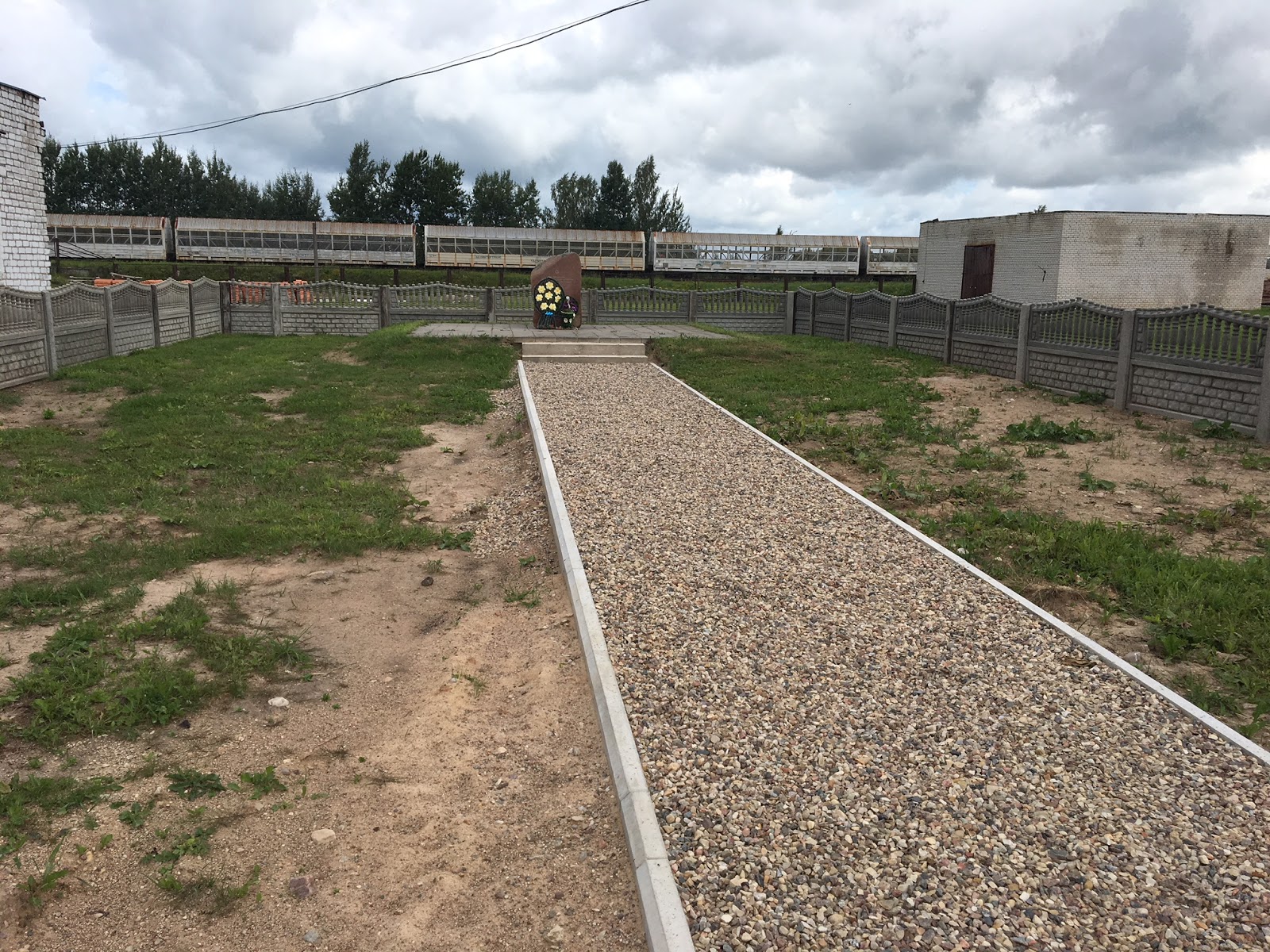
In 2004, Edna visited Parfyonova, Belarus, and with the help of a local resident, visited the holocaust site. She then raised money to erect a monument. I’ve seen the monument many times, and am glad that she took the initiative to memorialize it; this is a mitzvah that should not be left to a stranger if at all possible.  I had believed the monument was erected by strangers, and was glad to be mistaken.
When I prepared a slide show for Edna, I reviewed correspondence with Pavel Yurmashev, a Belarusian who has been helping to beautify the site. I met Pavel in June at a reunion of the Bolash family in Parfyanovo. After making the holocaust site visible from the street by moving a fence, he planned some landscaping and the addition of a bench in the Fall. The idea for the bench came from Rabbi Marc Mandel. When I wrote that I was coming in September, 2019, he accelerated the plans to this summer.

monumnet dedication 2005
Shabbat Shalom from Newport and Jerusalem!
monumnet dedication 2005

Thank you to Rabbis Mandel and Kleiner for sharing their words, and to Beth Ginsburg Levine for editing.

monument site 2018


Saturday, February 16, 2019

Winning the game

Winning the game At Touro Synagogue February 9, 2019 By  AARON GINSBURG                                                                                                    ALSO ON FACEBOOK

Wedding of Beth Ginsburg and Alan
Levine, January 15, 1978 Newport, RI
l-r Aaron, Judy & Beth Ginsburg, Alan
Levine, Dorothy Pokross Ginsburg
The Patriots did it again. But Rabbi Marc Mandel’s sermon was not about winning a game of football but about winning the game of life.
“Well, the Patriots are the Super Bowl champs again! Robert Kraft, Bill Belichick, and Tom Brady have created a dynasty, and this year we had a Jewish MVP most valuable player, Julian Edelman. We are living through an amazing time in New England sports, with the Patriots, the Red Sox and the revived Celtics.
“How much of a role do sports play in our lives? Rabbi Menachem Penner, the head rabbi at Yeshiva University, asks an interesting question. Is it ok to pray for your favorite sports team? Rabbi Penner says there are two ways to look at this.
“On the one hand, praying for a sports team could be a wasted prayer. The Midrash says, you only get so many prayers. Let's say a person prays for a fancy sports car. Then, when they get the car, they realize how expensive it is to fix. What should they have prayed for? A fancy sports car that never breaks down. You only get so many prayers.
“On the other hand, says Rabbi Penner, people relate to God in different ways, and perhaps some people relate to God through sports.
“Rabbi Tzvi Sobolofsky says that sports are good way to relax, but if you elevate sports, what is it taking the place of? Rabbi Sobolofsky suggests watching the Super Bowl without the commercials and the halftime show, thus gaining an hour to learn Torah. Rabbi Sobolofsky says that Super Bowl Sunday is like Yom Kippur for him. For several hours, no one calls him or bothers him.
“Let's learn from these rabbis how to manage sports in our lives.”
Our lives are finite. If we fail we may get a second chance, but we can’t depend on it. We need to use our time wisely to accomplish our goals, while leaving room for second chances and new experiences and challenges. And we need to make the most of each experience.
In my family Super Bowl Sunday has a special significance. My sister Beth married Alan Levine on Superbowl Sunday, January 15, 1978. I’m not sure I was aware of the superbowl at the time. We were more worried about the winter weather. The evening before, when the visibility was close to zero, a plane crashed into the water while we were having a get together for the out of towners at the Sheraton Islander. The bartender on the top floor restaurant ran to the window to take a look.
During the last two weeks I have been traveling in Israel. Nature uses time effectively. A little rain and sun and Israel begins to bloom. I saw this when I visited Rosh Hanikra Beach Nature Reserve, which is near the border with Lebanon, adjacent to the Rosh Hanikra Grottoes.
As an Israeli patrol boat watched for trouble, amid the rocks, shore birds such as the anafa אנפה flew, soil clung and flowers poked out, including the persian cyclamen (rakefet, רקפת) and the crown anemone (kalanit metzuya כלנית מצויה). Both flowers became the theme of famous Israeli songs, Kaloniot at https://youtu.be/QHq3bb4J1Ww and Rakefet at https://youtu.be/0pJWn9ZmzIc
To use my time effectively, I am in contact with people constantly, by phone, WhatsApp, email and Facebook messenger. Sometime a chat group using WhatsApp is the easiest way to coordinate and share information. If there is not a language barrier it is easy to meet someone who is retired. Many people are overcommitted and have difficulty agreeing to a time or place until the last minute.
It’s helpful to have a base in Israel. Fortunately, Moshe bar Z’ev and his wife Carol Fuchs are providing a base in Jerusalem. They also provided a base in Luxor, Egypt last month. Moshe’s ancestors also came from Dokshitz, where many of Newport’s Jews originated.
Zvia Frankfurt, whose parents were from Dokshitz, helped arrange and accompanied me when I met Shoshana Meltzer Weinbaum and her daughter Yehudit, son Moshe and daughter-in-law Malka. Shoshana was born in Dokshitz and lived in Parafyanovo until she was 9 years old. She remembered some of my relatives. Parafyanovo is six miles from Dokshitz. Shoshana also identified people in pictures taken in the shtetl during the 1920s and 30s. She wrote a short chapter in the Dokshitz-Parafyanovo Yizkor book.
I have also met olim (immigrants to Israel) Linda Ben-Zvi from the United States, Michelle Slone and Aaron Polliack from South Africa, Yosef Malkin from Russia, and Regina Zhuk from Riga, Latvia. Regina is a Friedman and related to Newports’ Friedmans. They all trace their roots to Dokshitz. I had Shabbos dinner with Howard Feldman and family. Howard’s father was born in Glubokie (just to the north of Dokshitz).
Among the children of immigrants who were born in Dokshitz I met Nurit Azoulay, whose father Zvi Gilenson was born in Dokshitz (He wrote a chapter in the Yizkor book), Menachem Markman and his wife Avigail (Menachem’s father Zvi wrote four chapters in the Yizkor book), and Eitan Kremer (a Newport Friedman family relative).
Arie Henkin looking at map he made of
new section in Dokshitz (created about
1920), 
In Lehavim I revisited Arie Henkin. Each time you visit someone you learn something new. Arie told me that his mother and brother were stranded in Dokshitz after his father left for Palestine in 1936. To get a visa his father said he was the father of an acquaintance already in Palestine. When his father tried to get a visa for his family to follow, a British official noticed a discrepancy and the visa was denied..
Arie and his mother were sent into exile by the Russians. The train left Parafyanovo on the day Germany invaded Russia. This involuntary exile saved their lives. Arie’s brother disappeared. He probably was arrested by the Russians, and killed by them at the time of the invasion. Arie and his mother made it to Palestine in 1946.
Arie’s story is in the recently published English translation of the Yizkor book.
May you manage your time and your blessings effectively!
Shabbat Shalom from Jerusalem
Thank you to Beth Ginsburg Levine for editing and to Zvia Frankfurt for helping with the names of the bird and flowers, Moshe Bar-Z'ev for musical insights, and Rabbi Marc Mandel of Touro Synagogue Newport, RI for Torah insights.


Jerusalem
with Aaron Polliack
with Michelle Slone
with Regina Zhuk
with Nurit Azoulay
with Eitan Kremer
with Yosef Malkin


Thursday, February 14, 2019

Rabbi Mandel goes to the super bowl

Rabbi Mandel goes to the super bowl
at Touro Synagogue
February 2, 2019

Edited by Beth Ginsburg Levine

ALSO ON FACEBOOK


It’s that time again. Super Bowl Sunday is approaching,  if you like to shop, it’s a good day. Many people will be preoccupied .

Is there a lesson that the New England Patriots can teach us?

On Shabbat, Rabbi Marc Mandel of Newport’s Touro Synagogue expounded,

“Tomorrow is the big game. Once again, the Patriots are in the Super Bowl. How do the Patriots make the Super Bowl so many times? Coach Belichick says that the reason is because every person on the team plays a role. They have great teamwork.

“If you look at the Torah, in the book of Genesis there was no teamwork. It was each person for himself. It was Adam vs Eve, Cain vs Abel, Sarah vs Hagar, Jacob vs Esau and Joseph against his brothers. But as soon as Exodus began, so did the teamwork. Miriam watches her brother Moses in the water and Aaron helps his younger brother lead the nation.

“Let us learn from the Torah and the Patriots that the secret to success is teamwork.”

When I was in Egypt admiring the pyramids, which were already a tourist attraction when the Children of Israel were there, I wondered how they were built. Some of my acquaintances can’t believe that the “primitive” ancient Egyptians could manage it, and infer that a visitor from outer space was involved. They may be under the impression that our technology means that we are smarter.

I stumbled on a video by Bettany Hughes with the answer. https://youtu.be/f5JRJhmrOx4

Although the Egyptians didn’t have high tech there was plenty of labor at hand. The flooding of the Nile meant farm workers had almost six months a year available. It was a win win. They could make a little money and help ensure Pharaoh’s and Egypt’s second life.

The workers lived in a city built for them.  The work was very organized. The largest pyramid consisted of one million blocks. The blocks were quarried near the site of the pyramid. They were hauled on sleds by gangs of 20 workers, up a ramp as the pyramid got higher.  Each stone was finished after it was placed in its position.

In the drawings from ancient Egypt, as the blocks are being pulled, a man is shown pouring water on the sandy surface. Recent studies have shown that if the right amount of water is in the sand, about 5%, the amount of friction is reduced by almost half, meaning that fewer people can do the same work.

The work was dangerous. If a block slipped ahead of you, death or severe injury would result. The foremen got everyone to work a little harder by offering extra beer to the group that was the most productive. Ancient Egyptians and football fans will go the extra mile for a six pack.

Go Patriots!

May your sand and beer each have the optimum percentage of the appropriate liquid. And may each of you have the right amount of ruach (spirit) to be at the top of your game.

Shabbat Shalom from Shlomi, Israel