Monday, February 27, 2017

At Touro Synagogue, February 25, 2017

At Touro Synagogue, February 25, 2017
The big and the small of it; the Rabbi and Dr. J

Rabbi Marc and Jackie Mandel were back in Newport after their brief sojourn in Detroit. They had the special glow that new grandparents have.

Rabbi Mandel spoke with his customary brevity and flare, starting with an incident from the trip to Detroit. He segued to a short but tantalizing discussion about a big subject, the nature of the laws we live by.

"Shabbat Shalom

"Jackie and I are glad to be back in Newport and we thank the Congregation for all the wishes of mazel tov on our new grandson. Last week Jackie and I drove to our grandson’s bris in Detroit; our GPS took us through Canada. We didn't realize this in advance, and we didn’t have our passports. So we were stuck in the immigration office at the border for about an hour. 

"We were in the hands of gun-toting officials who went about their routine. Jackie produced a key piece of evidence-a picture of our grandson, Abie, on her cell phone. Tired after a full day on the road, we anxiously awaited their decision. Finally, we received permission to enter Canada.

"Of course every country has laws about entering their territory. These are very common laws similar to the type of laws we read about in this week’s Parsha, Parashat Mishpatim. Mishpatim means laws. Every society and every country has laws. Not all laws are good. The Nazis had the Nuremberg Laws, which excluded the Jews from all German life; these were horrible laws for the Jewish people.

"What is the most famous law in this week's Parsha?

"I believe it would be, ‘an eye for an eye, a tooth for a tooth’  (עַיִן בְּעַיִן שֵׁן בְּשֵׁן) This passage in the Torah has often been misunderstood."

I thought that the Rabbi might mention Shakespeare's play, The Merchant of Venice. Sure enough, he did. In the play, the Jew, Shylock, demands that a pound of flesh secure a loan to a Christian. 

Rabbi Mandel continued, "The Talmud explains that the Torah never meant to take a person’s limbs if they harmed someone. The law is that you are compensated financially if you are injured."
Was Shakespeare being Talmudic in The Merchant of Venice? Shakespeare was a master a punning and double entendres. On the one hand, Shylock is a stock figure, a stereotype, but on the other hand, he rises above the stereotype.  Although he is bitter, he is also noble and proud.

[From The Merchant of Venice:

SALARINO
Why, I am sure, if he forfeit, thou wilt not take
his flesh: what's that good for?

SHYLOCK
To bait fish withal: if it will feed nothing else, it will feed my revenge. 

He hath disgraced me, and hindered me half a million; laughed at my losses, mocked at my gains, scorned my nation, thwarted my bargains, cooled my friends, heated mine
enemies; and what's his reason? I am a Jew. Hath not a Jew eyes? hath not a Jew hands, organs, dimensions, senses, affections, passions? fed with the same food, hurt with the same weapons, subject to the same diseases, healed by the same means, warmed and cooled by the same winter and summer, as a Christian is? If you prick us, do we not bleed? if you tickle us, do we not laugh? if you poison us, do we not die? and if you wrong us, shall we not revenge? 

If we are like you in the rest, we will resemble you in that. If a Jew wrong a Christian,
what is his humility? Revenge. If a Christian wrong a Jew, what should his sufferance be by Christian example? Why, revenge. The villany you teach me, I will execute, and it shall go hard but I will better the instruction.]

Rabbi Mandel continued, ”The  Rabbis in the Talmud explained that you can’t interpret this passage according to its literal meaning. They had license to reinterpret the meaning of the passage. The Talmud explains that the Torah mandates a sophisticated, five part monetary form of compensation consisting of payment for damages, pain, medical expenses, incapacitation, and mental anguish.

"Laws, to be respected, need to respect all people.

"Shabbat shalom!"

Visiting from Manhattan were Jamie and Dena Small. Dena grew up in Detroit. She was very familiar with the Detroit scene and the places the Mandels saw during their visit. Jamie's parents are David B. and Sandy Kline Small, so Kline married Small-and their son, Jamie, is not tall!  

David Small shaking the hand of Dr J,
Marc Mandel is standing behind 
David,
It's a small Jewish world. Rabbi Mandel realized that he knew Jamie's father, David B. Small. Marc Mandel and David B. Small both grew up in Far Rockaway, NY, and went to Camp Hocus Pocus together… no, make that Camp Tagola. 

Pictured is David Small shaking the hand of  Julius Erving, commonly referred to as Dr. J. Marc Mandel is standing behind his friend, David.

Dr. J is one of basketball's greats. He is well known for the slam dunk, which he combined with other moves into an art form. He dropped out of the University of Massachusetts Amherst in 1971 to join the American Basketball Association, but made a point of completing his education in 1986 to fulfill a promise to his mother through the UMASS University Without Walls program.

In 2008, Dr J. visited Israel with fellow star Rick Barry in support of the Migdal Or youth village for underprivileged children. He told Israel's president, Shimon Peres, "I am truly inspired to be an ambassador for the country and for the village."

Dena Small, a student of literature, is a lover of books. When Rabbi Mandel mentioned that the name of the protagonist, David Small, in the book by Harry Kemelman, z.l.,  Friday The Rabbi Slept Late, had the same as her father-in-law, she was delighted. We then learned what rabbis like to collect: rabbinical books. Rabbi Mandel pulled five books of the When the Rabbi Slept series from his bookshelf.

Author Harry Kemelman lived in an old New England port not dissimilar to Newport, Marblehead, MA, and was friendly with his rabbi. Every rabbi should have his Kemelman. Rabbi Mandel, you are on notice!


Any way you slice it, it's a small world. read more from Jewish Newport  on the web or on facebook contact me

Thursday, February 23, 2017

At Touro Synagogue February 18, 2017

At Touro Synagogue February 18, 2017

I don’t get no respect!


On Shabbat Rabbi Marc Mandel and his wife Jackie were in Detroit kvelling over their newborn grandson. But we were in good hands. Dr. Jim Herstoff led P’sukei D’zimra and Shacharit, Sam Spencer leyned Torah and delivered the sermon, and Carmi Mandel led the balance of the service. There was a minor tiff when someone thought their usual seat was occupied, but the offender gracefully said, “I’ve been saving this seat for you!” Order was soon restored.

We read Parashat Yitro, Exodus 18:1 - 20:23, one of the Torah’s the shortest parshiot. In a burst of optimism Rabbi Mandel tried to recruit yours truly; in a burst of realism Sam Spencer got the job. Co-president Dr. Naftali Sabo pointed out that Sam had the accent on the last syllable, in the Sephardic fashion. 

There was a lot doing in the Parsha. At the beginning, Moshe’s father-in-law, Jethro, cautioned Moses against overextending himself and advised him to delegate some of the work. Moshe followed the advice. Nowadays, I wonder how many men accept a suggestion from a father-in-law, should one be courageous enough to tender some  advice.  

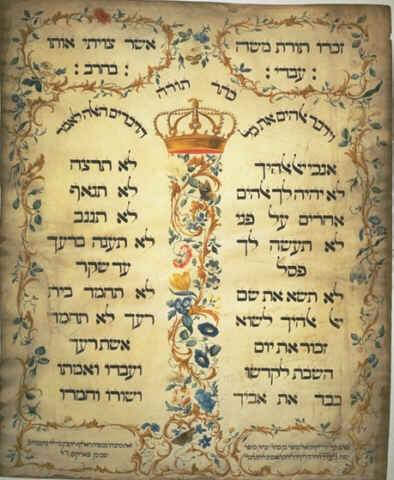
Decalogue Parchment
Yuketiel Sofer 1768
The highlight of the Parsha was the ten commandments, Asereth ha-D'bharîm עשרת הדברים, literally the ten words. The moniker “ten commandments” is a recent, and not a Jewish, innovation.  Sam mentioned the division of the commandments between the first five, which are between God and man, and the second five, which are between man and man. 


The fifth commandment, “Honor thy father and thy mother,” seems like it is out of place. Sam told us that the commandment teaches two important lessons, that there is something more important than ourselves, and that we did not come out of nowhere. He also said that honoring God and honoring our parents are connected, and that this honor should be extended to all, since we are created by and in the image of God. 

This is very much in tune with Jewish tradition, which extends the honor to step-parents and others that raise us, including siblings, grandparents and others, whether they are related or not, and to our teachers. 

Honor has its limits, and we are not expected to break a commandment at our parents request, nor to marry or not marry someone at their request.

In Judaism, honor is a two way street, and parents are expected to honor the children who honor them. 

I know you’ve been wondering, so I have the name of Rabbi and Jackie Mandel’s grandson from a reliable source, “His English name is Abie and his Hebrew name is Noam Avraham. He is named after Rabbi Mandel's father who was Avraham and after his father Yaakov's grandfather who was also Avraham.” 

Shabbat Shalom! read more from Jewish Newport  on the web or on facebook contact me


read more about the decalogue  or  the fifth commandment  on wikipedia

Saturday, February 11, 2017

At Touro Synagogue February 11, 2017

At Touro Synagogue February 11, 2017
Houses are made of trees
by Aaron Ginsburg

It was a snowy weekend in Newport.

The inside of Touro Synagogue has been scraped in preparation for painting. It reminded co-president Dr. Naftali Sabo about the tradition of not finishing a building, to remind us about the destruction of the Beit Hamikdash, literally, "The Sanctified House,” the Temple in Jerusalem.  

This is an ancient custom, from the Talmud, Baba Batra 60b, “Rabbi Yehoshua said to them: ‘My children, come, and I will tell you how we should act. To not mourn at all is impossible, as the decree was already issued and the Temple has been destroyed. But to mourn excessively as you are doing is also impossible, as the Sages do not issue a decree upon the public unless a majority of the public is able to abide by it, as it is written: ‘You are cursed with the curse, yet you rob Me, even this whole nation’ (Malachi 3:9), indicating that the prophet rebukes the people for neglecting observances only if they were accepted by the whole nation.’ ”

Rabbi Yehoshua continues: “Rather, this is what the Sages said: ‘A person may plaster his house with plaster, but he must leave over a small amount in it without plaster to remember the destruction of the Temple.’ ” source: The Davidson Talmud at sefaria.org  

This was a prohibition against excessively mourning the Temple’s destruction. We need to be careful, lest excessive mourning prevents us from building our houses.

Rabbi Marc Mandel said,  “Today is the 15th of Shevat, Tu B’shvat, the Jewish New Year for Trees. In recent years, this holiday had been reclaimed as we all become more in tune with environmental issues such as climate change and global warming.

“Tu B’shvat, the winter holiday, when the tree sap begins to rise, has become a rallying point for environmental issues, integrating Jewish living and the natural environment.

"The point of connection between trees and Jewish tradition are rich and many. 

“When we return the Torah to the ark, we sing, from the third chapter of proverbs, עֵץ-חַיִּים הִיא, לַמַּחֲזִיקִים בָּהּ;    וְתֹמְכֶיהָ מְאֻשָּׁר.-'It is a tree of life for those who grab on to it; happy are all that hold fast onto it.’

“In Parashat Shoftim, Sefer Dvarim 20:19, it says, כִּ֤י הָֽאָדָם֙ עֵ֣ץ הַשָּׂדֶ֔ה, ‘For a human being is like the tree in a field.’

“Using these kinds of metaphors in the Torah indicates that the Jewish religion is concerned about the environment and the possibility of global climate change.

“There are environmental halachahs about cutting down trees, and giving the land a rest, among other Jewish laws connected to the environment. Jewish traditions and customs are connected to the calendar, which tracks the seasons and the moon’s cycle and its rhythms. 

“Rabbi Eliyahu Safran from Baltimore writes that, 'Rabbi Yisroel Zev Gustman from Jerusalem was a Holocaust survivor, and he used to work in his garden every day. He told his students that, before the Holocaust, his teacher, Rabbi Chaim Ozer, showed him which vegetation was edible-and this saved his life when the Nazis invaded Vilna and he escaped into the forest. The trees, literately, provided for his physical existence.’

“Both trees and people are sources of blessing and potential benefit to society. Both, too often, are violently cut down. Let us hope and pray we will learn to respect human life and the natural world that surrounds us. Shabbat Shalom!”

Eti Hasadeh, A tree in the field is a poem by Natan Zack which was set to music by Shalom Chanokh. Read the moving words. The first line says it all. "For man is like a tree in the field" כי האדם עץ השדה


The builders of Touro Synagogue were planting a tree of Jewish knowledge, in a place where there were not many such trees. Cliff Guller pointed out that Touro Synagogue was literally built from trees-the columns being solid tree trunks.

In today’s parsha, Beshalach, Exodus 13:17 - 17:16,  in response to complaints by the Children of Israel about bitter water, God instructed Moshe to throw a tree into the pool, which then became sweet.
וַיִּצְעַ֣ק אֶל־יְהוָ֗ה וַיּוֹרֵ֤הוּ יְהוָה֙ עֵ֔ץ וַיַּשְׁלֵךְ֙ אֶל־הַמַּ֔יִם וַֽיִּמְתְּק֖וּ הַמָּ֑יִם  "And he cried out to the Lord, and the Lord showed him a tree, and he cast it into the water, and the water became sweet." I can see Jackie Gleason heaving a tree into his swimming pool  and declaiming, “How sweet it is!”

It was appropriate that Dr. Naftali Sabo, who devotes his life to healing, should have the fourth aliyah. The aliyah ended with the words, כִּ֛י אֲנִ֥י יְהוָ֖ה רֹפְאֶֽךָ "For I, the Lord, am your doctor." Physicians are doing God’s work.

Another tree that we can plant is a child. There are spiritual children, intellectual children, and physical children. Students are the descendants of their teachers. 

According to the Mathematics Genealogy Project, my cousin, mathematician Marvin Shinbrot, had five descendants. Marvin did a lot of classified work early in his career; he eventually had second thoughts, became an active Vietnam War opponent, and moved to Canada after losing his job at Northwestern University. He continued his career at the University of Victoria. I wonder if he would have gone to Uvic after watching this video:

Speaking of planting a tree, mazel tov to Kayla (Mandel) and Yaakov Lasson on their son’s birth. He was born Thursday morning, and is the first grandchild of Rabbi Marc and Jackie Mandel.

Houses are made of trees. @tourosynagoguenewport


Tuesday, February 7, 2017

At Touro Synagogue, February 4, 2017

At Touro Synagogue, February 4, 2017
It’s not over until it’s over

by Aaron Ginsburg

When I arrived in Newport after dark on Friday evening, there was a noisy flock of birds on the tree between the Rabbi’s house and the Levi Gale house. A neighbor started banging to frighten away the flock, but in vain. The boistrous  squawking reminded me of The Birds, a movie by Alfred Hitchcock, based on the story by Daphne du Maurier. In the movie, things went from bad to worse, as it did for the Egyptians in the parsha, which continued the story of the plagues.

In Parshat Bo, Exodus 10:1 - 13:16, there was nary a bird, but there were other winged creatures, locusts.  וְאָכַל֙ אֶת־כָּל־הָעֵ֔ץ הַצֹּמֵ֥חַ לָכֶ֖ם מִן־הַשָּׂדֶֽה׃ (And they shall eat away all your trees that grow in the field.) 

There were neither birds nor locusts in shul. But there was a big gorilla, the upcoming Super Bowl, which Rabbi Marc Mandel addressed in his sermon:

“Tomorrow is the big day – Super Bowl Sunday – when millions of people will be tuning in for the big game. Rabbi Moshe Meir Weiss from Staten Island wrote an interesting article about the Super Bowl, which I have adapted for Patriot Nation. Rabbi Weiss’s take on football is at http://thevuesonline.com/articles/super-bowl-musings/.

“He said that the Chofetz Chaim taught us that you can learn something from everything. For example, the Chofetz Chaim said, “What can you learn from a telephone? We learn from a telephone that you can say something in one country it can be heard in another country.” (He was talking about the power of speech and lashon hara or gossip.)

"So Rabbi Moshe Meir Weiss asked, ‘What can we learn from football? One of the basics of the game is that you always try to get a first down. A first down is a whole new start. This is very important in Jewish life. As Torah Jews, we are always trying to make a fresh start. We say in Ashrei, וַאֲנַחְנוּ, נְבָרֵךְ יָהּ--    מֵעַתָּה וְעַד-עוֹלָם הַלְלוּ-יָהּ  (We will bless God from now until eternity.) We have been doing this for decades. Why from now? Each time is a fresh start! If It's new, from now on it will be more meaningful and heartfelt. We are always going for the first down!’ ”

“In the parsha for today we read הַחֹ֧דֶשׁ הַזֶּ֛ה לָכֶ֖ם רֹ֣אשׁ חֳדָשִׁ֑ים רִאשׁ֥וֹן (This month shall mark for you the beginning of the months.)The Jewish people are compared to the moon-we are always renewing ourselves. 

“The objective of football is to make a touchdown. That's all that matters! In the last election Hillary Clinton got more votes than Donald Trump. But that wasn’t the point of the election. The point of the election was to win. It's always important not to lose sight of the goal.

“That's an important lesson. In life, we need to focus on goals. We need to set goals, spend the time with our children, giving a certain amount of charity, and learning the parsha each week. Set goals! Life will be more meaningful. With the fulfillment of goals comes the joy and thrills of scoring a touchdown. Robert Kraft, owner of the Patriots, who is a member at Temple Emanuel in Newton Massachusetts, said, ‘The Patriots prepare very, very hard for each game. It's like studying Torah-it's just not simplistic. It’s deep.’ ” 

Now that the game is over, what else can we learn? We learn that, “It’s not over until it’s over.”

The Family by Samuel Bak
In the Vilna ghetto, there was a young boy who was a precocious artist. His first exhibit was in the ghetto in 1943 at the age of 9 years. Later that year, after the ghetto was liquidated, he and his mother joined his father in a forced labor camp. He survived the liquidation of the children in the camp. 

His desperate mother, about to turn herself and her son into the Nazis, reasoned, “We will all be killed. Why prolong the agony?”  A neighbor understood what was about to happen, and pulled them into her apartment with the words, “You can worry about dying later.”


The boy, Samuel Bak, a renowned artist, lives in Boston. It’s not over until it’s over.

Friday, February 3, 2017

At Touro Synagogue, January 28, 2017

At Touro Synagogue, January 28, 2017
The Big Mysteries of the Parsha

by Aaron Ginsburg


Over shabbat, the Hebrew High School of New England (HHNE) came to Newport for a shabbaton. They added at least 30 people to the crowd and it almost seemed like July and August. 


When Mike Josephson entered shul and looked to his right, he quipped, “What have we got here, the basketball team?” About 10 students were sitting on the banquettes, including one wearing a numbered jersey.

At Rabbi Mandel’s request, Aharon Skoglund davened shacharit. Since it was Rosh Hodosh Sh’vat, hallel was included. It was a good choice. Aharon Skoglund teaches Judaics and music at HHNE.

In Parashat Vaera, Exodus 6:2 - 9:35, Moses and Aaron speak to Pharaoh. In a parody of magic and miracles, they dueled with Pharaoh’s necromancers to impress. Their words and accompanying tricks did not impress Pharaoh, who hardened his heart.

Rabbi Mandel usually describes each aliyah before it is read. He said that Pharaoh's stubbornness seemed like he had lost his free will. Since Judaism believes in free will, he said that, "This is one of the big mysteries of the Parsha." I lit up when I heard that. I thought, “What are the other big  mysteries of the parsha?” When I asked the Rabbi, he demurred. I think he may regret that.

Working with my friends, I came up with a short list of additional parsha mysteries.

  1. Why didn’t God just hand Moses the written Torah?
  2. Why did it take forty years to go through Sinai?
  3. Why doesn’t a levi get called up for the first aliyah rather than the second?
  4. What did God give Moses when he was sick?

Rabbi Mandel welcomed HHNE, 

“We are delighted to welcome the HHNE to Touro Synagogue. A few years ago the HHNE visited Touro Synagogue. Jackie, Carmi, and I met the school for the first time. We were so impressed that we felt this was the right school for Carmi. Thank you to Rabbi Bruce, to Dr. Nabel, the rabbis and the faculty, Stu, and the students for all you have done in making this an outstanding school. Thank you to past-President Gerry Goldberg and his wife Karen for all their dedication to HHNE. 

“A few weeks ago HHNE had their annual gala event and they had videos from some former students. These individuals are now outstanding professionals in medicine, law, and government. Hebrew High School is doing very good job. Day school education is important. 

“We are now reading about the Jews living in Egypt. Before they arrived in Egypt, they sent Yehuda ahead of everyone, to set up a day school. This is part of our culture and we are so grateful to all of you for supporting the school and making it so great. Carmi loves HHNE and all the activities there: he cares about the school so much and now he will say a short d’var Torah.”

Carmi said, "I'm so happy that my school, the Hebrew High School of New England, is spending a Shabbat in Newport RI. My family first found out about this school when they came to Touro 3 years ago. I'm so excited that we are all together as a school coming together as one united people. 

“When the school came here 3 years ago, we were taken in immediately as they were so welcoming and reached out to us. This has been a great Shabbat and I'm looking forward to having lots of ruach (spirit) and continuing to be very active in my school.”

“In the Parsha this week, Paroh, the leader of Egypt, did not allow the Jews religious freedom, or any freedom. But Moshe said, "Let my people go" and the rest as they say, is history.  Today, thanks to George Washington, and this synagogue, all Americans are free. We should not take our freedom for granted. 

“Let us pray for continued freedom and prosperity, Shabbat Shalom.”

I know you were all wondering about the Big Mysteries of the Parsha. The suspense is over:

  1. What did God give Moses when he was sick? Answer: This is an oldie but goodie. He was given two tablets! 
  2. Why didn’t God just hand Moses the written Torah? Why all fuss? Couldn't the Almighty just hand Moses the Torah or a memory card with the text? Answer: Moses lost his glasses, and couldn’t read it, so with God’s help, he had to memorize it.
  3. Why did it take forty years go through Sinai? Its really not that far, so something must have been slowing them down. Answer: The mishkan, the tabernacle, was a portable Temple, and must have been very large and heavy.  How fast can you go when you have to carry a mishkan? 
  4. Why doesn’t a levi get called up for the first aliyah rather than the second? Answer: At the aliyah auction, Aaron, who was a cohen, outbid Levi. The Levis have never gotten over it. 

And that’s the end of this week’s mysteries. Shabbat Shalom!


http://hhne.org/wp-content/uploads/2015/01/financial-aid-1.jpg

Tuesday, January 31, 2017

At Touro Synagogue January 21, 2017

At Touro Synagogue January 21, 2017

The Inauguration of Prophets
by Aaron Ginsburg

Dorothy Pokross Ginsburg
grammer school
It was a big weekend at Touro Synagogue, at least for me. In honor of my mother's yahrzeit I recited the haftarah. Before I could proceed, I was called up to the bimah for the maftir aliyah. After I made the bracha, as Rabbi Marc Mandel prepared to leyn the three verses from the torah, I said, “Hand me the yad!” He replied, “Huh.” I muttered something about a surprise, slipped my hands in my pocket, and turned on a prerecorded torah reading on my iPod.  Click to listen [then go back to previous page to continue.] Sounds pretty good, doesn't it?

Actually, for the first time in my life, I read from the Torah. It was one small step for mankind, one big step for Aaron Ginsburg. I want to give a shout out to Janet Zucker who made a recording for me to study. Now that I've broken the ice the rabbi wants to know when I'm going to be able to read a complete Pasha. Although I'm not usually reluctant to perform, in this I am. Who will come to my defense?
The parsha was Shemot, the first parsha from the book of Exodus. The subject was the inauguration of Moshe into prophethood. Moshe was a reluctant, somewhat argumentative prophet. His eyes were on the final goal, better treatment for the people of Israel, and he didn't hesitate to call G-d out if the results didn't come through fast enough.
וּמֵאָ֞ז בָּ֤אתִי אֶל־פַּרְעֹה֙ לְדַבֵּ֣ר בִּשְׁמֶ֔ךָ הֵרַ֖ע לָעָ֣ם הַזֶּ֑ה וְהַצֵּ֥ל לֹא־הִצַּ֖לְתָּ אֶת־עַמֶּֽךָ׃
Ever since I came to Pharaoh to speak in Your name, he has dealt worse with this people; and still You have not delivered Your people.”
וַיֹּ֤אמֶר יְהוָה֙ אֶל־מֹשֶׁ֔ה עַתָּ֣ה תִרְאֶ֔ה אֲשֶׁ֥ר אֶֽעֱשֶׂ֖ה לְפַרְעֹ֑ה כִּ֣י בְיָ֤ד חֲזָקָה֙ יְשַׁלְּחֵ֔ם וּבְיָ֣ד חֲזָקָ֔ה יְגָרְשֵׁ֖ם מֵאַרְצֽוֹ׃ (ס)
Then the LORD said to Moses, “You shall soon see what I will do to Pharaoh: he shall let them go because of a greater might; indeed, because of a greater might he shall drive them from his land.”
In the haftarah we learned about the inauguration of another reluctant prophet, Jeremiah. His excuse was that he was too young, only 12 years old. This ploy didn’t dissuade the Almighty, who patiently but firmly insisted. When the Ubershter summons you saying no is not usually an option.
וָאֹמַ֗ר אֲהָהּ֙ אֲדֹנָ֣י יְהֹוִ֔ה הִנֵּ֥ה לֹא־יָדַ֖עְתִּי דַּבֵּ֑ר כִּי־נַ֖עַר אָנֹֽכִי׃ (פ)
I replied: Ah, Lord GOD! I don’t know how to speak, For I am still a boy.
וַיֹּ֤אמֶר יְהוָה֙ אֵלַ֔י אַל־תֹּאמַ֖ר נַ֣עַר אָנֹ֑כִי כִּ֠י עַֽל־כָּל־אֲשֶׁ֤ר אֶֽשְׁלָחֲךָ֙ תֵּלֵ֔ךְ וְאֵ֛ת כָּל־אֲשֶׁ֥ר אֲצַוְּךָ֖ תְּדַבֵּֽר׃
And the LORD said to me: Do not say, “I am still a boy,” But go wherever I send you And speak whatever I command you.
Politicians are also species of prophet but a reluctant politician is an oxymoron.
Rabbi Mandel focused on the presidential inauguration with insights into the torah and into life. 
"We now have a new president: yesterday, in Washington, Donald Trump was inaugurated as the 45th president of the US. My old neighbor from Los Angeles, Rabbi Marvin Hier, the dean of the Simon Wiesenthal Center, said a prayer at the inauguration. Not everyone felt that Rabbi Hier should have accepted this invitation. 
"In the parsha this week Moshe was asked to speak to Pharaoh, but he turned down the offer to speak: Should Rabbi Hier have turned down the offer to give a prayer at Donald Trump's inauguration?
"Time magazine wrote, “Rabbi Marvin Hier must bow out of Donald Trump’s inauguration.” Time magazine says, "Rabbi Hier, don't spoil your legacy!"
"A few months ago Rabbi Haskel Lookstein accepted an invitation from Donald Trump to speak at the Republican convention: But Rabbi Lookstein changed his mind when his former students at the Ramaz School wrote a petition asking him not to speak. There was also a petition asking Rabbi Hier to change his mind but he didn’t.
"Rabbi Hier said, “I don't agree with everything Trump says, but the presidential inauguration is a time for all Americans to celebrate the peaceful transfer of power. There are no tanks, no planes, no guns–so I was deeply honored and I accepted.” Did he do the right thing? 
"Look, in the parsha Moshe didn’t want to speak to Pharaoh-but in the end he did go speak to him. And remember, in an earlier parsha, Yaakov blessed a different Pharaoh. So this is a complicated issue.
"Let us hope and pray that all American citizens are blessed-and let us remember the words of our first President, George Washington, who wrote to our Newport congregation, quoting from Isaiah, 'May we all sit in safety under our own vine and fig trees and may there be none to make us afraid.' Shabbat Shalom."
At the kiddish, which I sponsored in honor of my mother, I spoke briefly about her life and then, at the Rabbi's request, I spoke about the Jewish Newport blog.
Our mother, Dorothy Pokross Ginsburg
By Aaron Ginsburg and Beth Levine 
The Karnowsky cousins; l-r, back row: Hinda Pritzker(Semonoff),
Dorothy Pokross (Ginsburg), Sylvia Kay (Hassenfeld);
front row: Rena Pritzker (Button), Dorothy Kay (Fishbein), c. 1940
My mother, Dorothy Pokross Ginsburg, z”l, was born in 1918 in Fall River, Massachusetts. She was the daughter of a homemaker and a paint and wallpaper man. Both of her parents were born in the Ukraine and came to the Providence and Fall River areas as children.
She attended the BMC Durfee High School. After high school, she got a job in the Enterprise, which was a chain of department stores. One day in September 1938, the store closed because of a storm. On the way home, the trees were blowing down around her. It was the Hurricane of 1938! 
wedding of Maurice Ginsburg 
and Dorothy Pokross.center, 
Jacob Pokross,  father 
When Dorothy married my father, Maurice Ginsburg in 1946, they settled in Newport, where Maurice was the proprietor of The Broadway Market. Their first home together was at Tonomy Hill, where housing for returning GIs was readily available. In what might have reflected the humble background of their families, neither Dorothy nor Maurice had middle names.
So now, instead of in a department store, Dorothy worked in a grocery store, where she was called Dot by everyone, including me. She worked alongside Maurice and was in charge of the sole cash register and bagging, and played a large role in the maintenance of the financial books.
On August 29, 1947, The Newport Mercury reported the purchase of a house at 40 Almy St. by Maurice Ginsburg and wife. In the very same issue there was news about Touro Synagogue receiving a Gilbert Stuart painting of Judah Touro.
My parents participated in a Christmas club savings account. These were intended to help people save for Christmas presents. But Dorothy and Maurice were saving so they could pay the bills. 
motherhood; Dorothy, Aaron 
and Maurice Ginsburg
The candy was right behind the cash register, including both the candy bars and the penny candy. I recall the boxes of Bazooka bubble gum, and especially the Frenchies and the Squirrels…from both the store and the United Hebrew School, and the 12 packs of Sweet Tarts, which debuted in 1962. Do you remember that?

motherhood: Dorothy, Beth (Levine), 
and Aaron Ginsburg
Not long before the store closed, we had two or three Bellevue Avenue customers. One day, fresh mint was ordered.That was not something we carried. My mother was not a cook. She did not have time to become skilled in the kitchen arts. Nor was she a gardener.  But behind our house on Holten Ave. grew some fresh mint, probably planted by the previous residents. So Dot told our longtime employee, Whitey, to stop by the house, pick some of the weed that was growing at the back of the house, wash it off, and deliver it. And he did!

Wedding of Miriam Dress to Charles Lasky;
 l-r Maurice Ginsburg,Dorothy Ginsburg, 
Mimi Dress Lasky, Celia Dress,
Sarah Karnowsky Pokross, Jacob Pokross
Dorothy was the mother of three children, myself (Aaron), Judy, and Beth. When I was born, it was a difficult birth, and eventually a c-section was needed. That meant Maurice’s first cousin, Dr Samuel Adelson, had to be interrupted. He was playing bridge.

Her duties did not leave time for hobbies...mothering the children and working in the store took up all of her time.

A year after Maurice’s death in 1965, Dorothy closed the Broadway Market. She went to work for Leon Siletchnick at the Lion Drug Co. and ran the front of the store for the remainder of its existence.   After a few years working for its successor, the Newport Prescription Center, she retired.
Wedding of Beth Ginsburg and Alan Levine; l-r. 
Aaron Ginsburg, Judy Ginsburg (Goldin),
Beth Ginsburg Levine, Alan Levine, 
Dorothy Pokross Ginsburg

Dorothy started a new career as a volunteer.  She enjoyed and was proud of her work at the Newport Hospital, and her duties fit in well with her early to rise, early to bed schedule.  Along with Jean Feinstein, she placed American flags on the graves of Jewish war veterans. She also was on the board of Touro Synagogue, and helped keep track of the dues.


Dot died in 1998 at the age of 79, having had the joy of watching her children marry, relishing her seven grandchildren and having her niece, the late Miriam Lasky, her husband Charles and children live only a few blocks from her.


About the Jewish Newport Blog
At Touro Synagogue 
Kiddish, January 21, 2017
by Aaron Ginsburg


After Rabbi Marc Mandel asked me to speak at the kiddish earlier this week about my Jewish Newport blog, I reviewed all its postings. I read that Marc Ladin said, "When you sponsor a kiddish there's a high risk of the Rabbi asking you to speak." Just like Moses and the prophets, it is customary to feign reluctance, but Rabbi Mandel can see through that. So here I am. 
I created the Jewish Newport Facebook group on Sunday, Oct. 31, 2010, when we had the memorial service for Rabbi Theodore Lewis. I took a few pictures and posted them to the group with a brief description. But I was the only member of the group. I was busy and not ready to devote my time to Jewish Newport.
I attended services here once in October 2014 and again in January 2015. In April 2015, I recited my bar mitzvah haftarah here for the first time since my bar mitzvah at Touro Synagogue in 19... that involved a lot of messaging with Rabbi Mandel and sure enough, I was invited to speak at the kiddish which I sponsored. I even slipped in a bar mitzvah speech after the haftarah. 
I attended Yom Kippur services in Newport in September 2015. And I liked it. The people were friendly and I knew many of them, the synagogue was beautiful, the service was familiar and the rabbi friendly and accessible. The smallness of the synagogue helped each person to stand out. It was impossible to get lost in a crowd. Kol Nidre by candlelight blew my mind. 
Beginning in December 2015 I started to come almost every week. In April 2016, I activated the Jewish Newport Facebook group which had been sitting dormant for 5 1/2 years. I added people to the group. 
On April 10, 2916, I made my first posting, briefly describing the rabbi’s pre-Passover sermon. I was really taken by the way Rabbi Mandel consistently came up with a short message, usually pointing out how to live a better and more thoughtful life. I made a couple of random posts. One was a picture of B’nai B'rith officers from the Touro archives and another of a B’nai B'rith bowling league championship pin from 1941. 
On April 20 I had my first breakthrough. I made a posting about the Newport Bus Company and the United Hebrew School including the story of how Bobby Friedman made an appeal to the bus driver to allow us to use discounted tokens to go home from Hebrew school. I then learned the part of the story I did not know, that Bobby's mother, Chickie, went the next day and gave the president of the bus company a talking to. 
The next big break was the 2016 community Passover Seder. I was fascinated by our visitor from South Africa who told the story of the SS Mendi, a troop ship that went down off the coast of England in 1917 with the loss of 800 mostly black South Africans. That posting became an article in the Rhode Island Jewish Voice.
Starting on May 15, I began posting every week. I try to get to know the visitors who often have an interesting story, summarize the rabbi’s sermon, and attempt to make something out of nothing. I draw on my own experiences to fill out the postings, and my own take on the parsha or haftarah. 
I blogged about the rimonim lawsuit and one of those postings became an article in the Boston Jewish Advocate. I wrote about the local reaction to the suit for the Rhode Island Jewish Voice. I called people up and got their opinions. I took some of them by surprise and they became very passionate, so passionate that the editor asked, “Did they really say that?”
One day a visitor sitting in front of me introduced himself and said, "I was bar mitzvahed here in 1963." I emphatically responded, “I was bar mitzvahed here in 1963.” It was Stephen Huttler. Stephen became a prominent Washington DC attorney and was in Newport to purchase a house. When I created the posting I researched his family history and mentioned the town where his grandfather came from, Husiatin, which is now in the Ukraine, including a picture of the synagogue there that was built in 1674. 
Once I noticed a well-dressed gentleman in front of me with an upside down tallis as well as an askew yarmulke. When I helped him with the tallis, I introduced myself. He was from Houston and said, "I'm playing hookey from a convention because I wanted to come to Touro." I asked him if he knew of a good friend of mine, Dr. Arthur Forman . He said that of course he knew Dr. Forman. In what can only be described as a royal "we," he added, "Dr. Forman was one of our best clinicians and very good with the patients." When Rabbi Mandel introduced him, I learned that I was speaking with Dr. John Mendelsohn, former head of the M.D. Anderson Cancer Hospital. Under Dr. Mendelsohn's leadership, the hospital became a $2 billion a year business. I'm not sure that's what Dr. Mendelsohn wants to be remembered for.
And then there was the trick drawer. When you pull out the drawers full of taleisim it doesn't take much effort for the drawer to pop out and fall on the floor. This happened to Rabbi Lowell Weiss's son, Avi. Rabbi Weiss took over and deftly replaced the drawer, probably because he had previous experience. As I phrased it in the posting in tribute to Star Wars, "Et ainsi la perturbation de la force a été résolue (The disturbance to the force is resolved).”
A good picture livens up the postings. On Aug. 9, 2016, I hit the jackpot. We had a special delivery of extra taleisim from the Levi Gale house in a Pabst Blue Ribbon beer box. I knew I had my picture for that week. But that was a special Shabbat because at the kiddish Ralph Klingbell spoke. He related the characteristics of people to the characteristics of the elements in the periodic table, with the number of protons in an element corresponding to a year. For example, Ralph said he was in his “Hafnium year-lustrous and silvery gray. Delia is in her lutetium year-she resists corrosion in dry, but not moist air and is counted among the rare earths.” That week, I included two color pictures, one of the periodic table of the elements and a second of a Pabst Blue Ribbon box.
I was in Atlanta for a Lasky bar mitzvah on the weekend of August 24 but I was still able to post an article. I had several informants tell me what happened. I pestered Wesley Fastiff's secretary for a copy of his speech, and I contacted, Jonathan Wagner, one of the attorneys who defended Touro Synagogue in the rimonim lawsuit. Jonathan wrote movingly about the opportunity to be on the bimah and to recite Kaddish at Touro Synagogue.
When I found out that the amount of pro-bono legal work was worth $1 million and that the synagogue presented a print of the National Park Service’s Touro Synagogue brochure, I pointed out that if a picture is worth 1000 words, then that print is worth a million words. 
I've gotten to know a lot of people, both visitors and locals, improve on my writing and thinking abilities including my wry but dry sense of humor. 
I have an editorial committee to keep me in line, including Rabbi Mandel, Stuart Green of Sharon MA, who is a real newspaper editor, and my sister Beth Levine who won't let me get away with a thing. Initially I also had help from Janet Zucker, also of Sharon. Although the committee is responsible for the typos, I am responsible for any errors.
I'll end with something from last week's posting. Last Saturday, we read in the haftarah that after David blessed his son Solomon, he told Solomon to murder three people, saying in one case,
“וְיָֽדַעְתָּ֙ אֵ֣ת אֲשֶׁ֣ר תַּֽעֲשֶׂה־לּ֔וֹ וְהוֹרַדְתָּ֧ אֶת־שֵׂיבָת֛וֹ בְּדָ֖ם שְׁאֽוֹל׃
You will know what to do with him and you will send his gray hair in blood down to Sheol!” That sounds pretty serious. I don't know about you, but if I see King Solomon hanging around, I'll be buying Clairol Nice N' Easy color 10/87 ultra light natural blonde. No more gray for me!
Shabbat Shalom! 
Shabbat Kiddush Winter Lecture Series
January 21 Kiddush Sponsor Aaron Ginsburg in observance of the yahrzeit of his motherDorothy (Pokross) Ginsburg
Dvora Bat Ya'akov ha'Levi v'Sara
דבורה בת יעקב הלוי ושרה
Kiddush Speaker Aaron Ginsburg
Aaron will talk about his blog on Jewish Newport.
The link to his blog is:
Facebook: www.facebook.com/groups/jewishnewport/
On the Web: jewishnewport.blogspot.com