Friday, March 15, 2019

I Bet You Can’t Sing Just One

I Bet You Can’t Sing Just One
At Touro Synagogue
March 9, 2019
also on facebook


On Saturday at Touro Synagogue in Newport, Rhode Island we celebrated a special occasion. Saul Woythaler finished the recitation of every haftarah, the weekly portion of the prophets. When Saul was done, the congregation sang in delight. Rabbi Marc Mandel filled us in on the history of the haftarah, without his usual call urging us to be better people.


“Saul’s great accomplishment raises an interesting question. Why do recite a haftarah each Shabbat?


“We read from the five books of the Torah. Why must we read from the prophets? Where does this custom come from? What does it mean? There are many different theories on this.


“Some say, the haftarah was introduced to give the people a sense of consolation and comfort. The words of the prophets are comforting. They give people hope. The five books of Moses are not written that way — they don't really give comfort. According to this theory — there was no set haftarah. Depending on what was happening to the community they chose a הפטרה to deal with that situation.


“Another theory is that the haftarah was used as a theme for the rabbi’s sermon. In other words, the haftarah was the introduction to the rabbi’s sermon. Thus the word haftarah. The word פטר means opening — it was the opening of the sermon.


Another theory is that the haftarah was introduced when the Jews were not permitted to read from the torah, during times of persecution. Thus the haftarah is always connected to the parsha to substitute for the missing parsha.


“Another theory is that not every community had a sefer Torah. It's not so easy to have a Torah in a community. It has to be handwritten on special parchment. It's not a simple matter. We live in the twenty-first century — you can buy a Torah online, but that wasn't always the case. So in communities where they didn't have a torah, they read a haftarah instead.


“Rabbinic scholar Reuven Margaliot says that the haftarah was introduced as a response to the Samaritans, a group that did not accept the holiness of the Temple in Jerusalem, nor did they embrace the authenticity of the words of the prophets. So they introduced the reading from haftarah with a special emphasis on the reports of Zion and Jerusalem.


“Whatever the reason is, we are here to celebrate with Saul today ashe has completed the entire cycle of haftarahs.


“It took Saul a very long time to complete all the haftarahs, because very often, this time of year, there are special Torah readings that would preempt the regular haftarah, so it had to be a leap year, and it had to be a year when the maftir was not preempted by a special Torah reading.


“We have a special diploma or certificate for Saul - we will give it to him after Shabbat.


“Saul - may you and Susan and family continue to be blessed with good health to continue all the great work you do for our community.


“Shabbat Shalom!”


Saul then led the service as the Shaliach Tzibur with a lilt in his voice as we returned the Torah to the Ark and recited musaf.


At the kiddish, sponsored by the Woythaler family, Saul explained that he had been reciting haftarahs since his bar mitzvah, and a few years ago decided to complete them. He gave tribute to his teachers, Rabbi Theodore Lewis and Rabbi Eli Katz.


Bob Davis continued with the theme of teachers, recalling, “After hearing Saul Woythaler honor the memory of the outstanding Hebrew education that Rabbis Katz and Lewis provided, I thought we should toast Rabbi Mandel for continuing the tradition. I also said that it occurred to me that the Rabbi's most cherished goal as a Rabbi would be to have his students praise his memory in the same fashion as Saul did.”


Rabbi Mandel added, “Saul was a personal inspiration to me to raise the bar higher for increased Torah learning at Touro, and that Rabbi Katz and Rabbi Lewis really did a great job educating this community. I was very touched by Bobby's comments about my role as a rabbi.”


The fun did not stop there. When Rabbi Mandel sang a song he composed for the occasion, he was joined by all (and you can join by singing along with his video), [blog continues below video]


“Saul makes us very happy ( la,la,la, )
He recites the Haftorahs very snappy ( la,la,la, )
He comes to shul every week ( la,la,la,
He probably doesn't get very much sleep ( la,la,la, )”

Shabbat Shalom from Jewish Newport!


Thank you to Rabbi Mandel and Bob Davis for sharing their words, to Rabbi Mandel for singing and to Beth Ginsburg Levine for editing.

Friday, March 8, 2019

The Redemption of Elie Cohen

The Redemption of Elie Cohen

At Touro Synagogue March 2, 2019

also on facebook

On Saturday the Cohen family sponsored a special Kiddush welcoming Marcia back to Newport from her trip to Arizona, in observance of the first yahrzeit of Dr. Elie Cohen, and in participation of Shabbat Across America. Hopefully, Marcia didn’t return for the weather.

I made an extreme effort to go,  gritting my teeth as I drove thru a snowstorm. I expected good food and good vibes and was not disappointed.

National Museum of American Illustration
 Marcia Cohen was there as were her three children and 
National Museum of
American Illustration
National Museum of American Illustration

spouses.

We had some visitors including Jack and Fern Eiferman from Brookline, Massachusetts. Jack left a brief review entitled “Haimish” on TripAdvisor, “Lovely Shabbat services on a snowy day. I don't usually daven in a shul with a mechitza, but the ability to gaze up and see the sun shining on my wife's punim made for a wonderful morning. People very warm, welcoming and friendly.” I suspect it was wife’s countenance that cast the light.  As an attorney, he is used to writing briefs. Rabbi Mandel has a different training but also is brief.

At Kiddush Jack told us they had visited the Museum of American Illustration, which he enjoyed. He was curious about the mezuzah on the museum door, so I explained that the museum creators, Judy and Laurence Cutler, are Jewish and members of our congregation. In a message he wrote, “Please convey my thanks to your fellow congregants, the Cutlers, who brought warmth to my heart when I saw (and kissed) their mezuzah at the Museum of American Illustration.”

Sometimes a ritual or a ritual object can bring us together in unexpected ways. 

In his words of torah, Rabbi Marc Mandel started with an obscure question about Purim, and soon progressed to the redemptions of Purim, Passover and Elie Cohen,

“Today we blessed the new month. This year on the Jewish calendar it is a leap year and we have an extra month. We have two months of Adar.

“Purim is in on the 14th of Adar. Which Adar? the first Adar or the second Adar? The custom is to observe Purim during the second Adar.

“The question is, ‘Why do we observe Purim in the second Adar?’ Don’t we have a rule,   אין מעבירין על המצוית Ain ma’avirin al hamitzvot “we don't pass up the opportunity to do mitzvot? As soon as we have an opportunity to do a mitzvah we do it - we don’t pass up the chance.

“So why don’t we observe Purim on the 14th of the first Adar? The Talmud teaches us that we want the redemption of Purim to be as close as possible to the redemption of Passover. Passover is in the month following Adar, in Nisan - so if we observe Purim in the fist Adar it would be too far from Nisan because the second Adar would be in the way.

“The two redemptions, the redemption of Purim and the redemption from Egypt on Passover, are related. The two redemptions are connected.

“Purim is the yahrzeit of Dr Elie Cohen. Eli had two redemptions in his life. The first redemption was when he was able to leave Egypt. Elie was at the top of his medical class, but the politics in Egypt at the time made it difficult for Elie to live, so he had his first redemption when he left Egypt.

“His second redemption is when he arrived in the states, met Marcia, and started his family: Today, Elie and Marcia have a great legacy of  Larry and Christine, Audrey and Joe and their children and Renee. What a wonderful legacy!

“So Elie had two redemptions and the redemptions are connected just like Purim and Passover are connected. Elie lived the life of Passover and Purim.

“He was proud of his heritage and he helped people of all faiths to find a better life of health and success in the United States.

“We miss him very much and when we observe Purim and Passover, we will remember the great redemptions of Dr Elie Cohen.”

Rabbi Mandel also mentioned that Elie was the first orthopedic surgeon in Newport, that he was the first to perform many types of orthopedic surgeries here, always strove to be on the cutting edge of medicine, and spent his entire life studying.

At the kiddish rabbi addressed a difficult issue. He read a brief poem,

Elie

“I didn't get a chance to say goodbye
The rules of endings did not apply.

Should I feel guilty, sand and upset
That we were permanently separated as the sunset?

Your life was successful and we thought it would always be,
Never imaging that you we would never again see.

You were always there for us when we would call,
Whenever it is was winter, spring, summer or fall.

Goodby Eli - maybe now we can say it.
It’s not what we expected, but we must submit.”

Death is not something that we can schedule. Often we can’t say goodby when a loved one embarks on the final journey.

Good Shabbos from Jewish Newport!

And don’t forget to kiss both your mezuzah and your significant other. It’s all about connecting to each other and to Judaism.

Thanks to Rabbi Mandel and Jack Eiferman for sharing their words, to Judy Goffman Cutler and the National Museum of American Illustration for the photos, and to Beth Levine Ginsburg for editing. The National Museum of American Illustration

Thursday, March 7, 2019

Keep Your Eye on the Ball

Keep Your Eye on the Ball

At Touro Synagogue February 23, 2019

also on facebook


After three weeks of sermons about the Super Bowl I think it’s time for a change. Baseball season is not far away.


Flying from Tel Aviv to Boston made for a long day. After just a few hours of sleep, I woke up at 5::45 AM on February 22 and drove from Jerusalem to Ben Gurion Airport. I was tired and circled in the large airport three times before I found the Hertz rental car return.  My flight left at 10:30 AM for Istanbul. My final flight landed in Boston at 5:59 PM. I took Logan Express to Braintree, and arrived at my Foxboro home at 7:47 PM. That adds up to 10 hours, to which 7 hours should be added to account for the time difference.


My trip was very successful. It took a week to recover from the exhaustion and to reset my clock. At the beginning I was having supper at 4 PM, and waking up the next day at 2 or 3 AM.


The day after I arrived I went to services at Touro Synagogue. I was a little bit late, and before I could sit down I was called to the bimah for an aliyah.


Rabbi Marc Mandel said,


“In our society we are very much focussed on being successful. We send our children to school at a young age - we want them to go to a good college and have good careers.


“We are all focused on success. What happens when there is failure? Do we know how to cope with failure?


“Success and failure is at the heart of this week’s parsha, Ki Tisa(Hebrew). The Jewish nation was successful. They witnessed the ten plagues, the splitting of the Red Sea. They received the torah at Mt. Sinai. People from all over the globe were attracted to Judaism. They were a successful people.


“Then came failure and the sin of the golden calf. A great nation falling for the fatal attraction of the golden calf! Entire families were swept up in this huge mistake. Even Moshe’s family wasn't spared - his brother Aharon participated in this event. What happened?


“Rabbi Shay Schechter explains that the Jews became distracted. They weren't really focused on God. It’s so hard to stay focused - especially today when we are all distracted by the technology that is all around us. Cellphones, e-mail, text messages, facebook, youtube, Netflix, twitter, instagram - how can anyone stay focused today? It’s impossible.


“That’s what happened to the Jewish people. They couldn't stay focused. Rabbi Schechter quotes the posuk from Shir Hashirim 4;9, לִבַּבְתִּנִי באחד (בְּאַחַת) מֵעֵינַיִךְ, “I loved you with one of my eyes.” What does that mean, “With one of your eyes?” The midrash says that while the Jews were receiving the torah, they had one eye on the golden calf. They were distracted by the glitter of the golden calf.


“This is the challenge we all have, to not be distracted from our main tasks.


“Shabbat Shalom”


Being easily distracted can sometimes be helpful. Our lives our insecure. We need to be alert to distractions because something important might be happening. It’s when the distractions take over that we can run into a problem.


When I am trying to accomplish something, I find that I constantly succumb to a distraction…the latest news and weather, e-mail, facebook, tuning into the background music, crossword puzzles (I prefer the New York Times Monday puzzle, which I can usually complete without getting everything right). And then there is the refrigerator. How much more might I accomplish if I kept my eye on the ball.


May you keep your eyes on the ball without being overly distracted.


Shabbat Shalom from Jewish Newport!


Thank you to Rabbi Mandel for sharing his words of torah and to Beth Ginsburg Levine for editing.

Friday, March 1, 2019

Newport and Jerusalem

Newport and Jerusalem

At Touro Synagogue February 16, 2019  

By  AARON GINSBURG                                                                                                    

ALSO ON FACEBOOK


On Friday evening February 15, I had the honor of spending Shabbat in Jerusalem with Benyamin Yakovian, his father and brother. When Benyamin visited Touro Synagogue, we enjoyed his davening immensely. His voice and his ruach filled the shul

In Newport, the Super Bowl was very much on people's minds. Rabbi Marc Mandel of Touro Synagogue said,

“A few weeks ago, in my sermon, I posed and answered, ‘What made the New England Patriots so successful? Perhaps the answer is their great teamwork.” After that sermon, Saul Woythaler said to me, ‘Perhaps the secret of the success of the New England Patriots is their coach. They have a great coach, just like Moshe was a great coach for the Jewish people.’

“There is no question that Bill Belichick is a superb coach and that he has helped the Patriots become a great team, and there is no question that Moshe was a great coach for the Jewish people and he helped them become a great nation.

“…As we say in Yigdal, there was never another Prophet like Moshe. Still, his siblings Aaron and Miriam were angry at him and wanted to know why he thought he was so special when they too were prophets. But God said there is a difference between you and your brother, because he has abilities that no Prophet ever had or will ever have again. Moshe could see things that no other Prophet could see, and perhaps Bill Belichick is a coach that can also see things that no one else can see.  

“It's hard to find a great leader and this is a challenge that we all face in our times. Let us hope and pray that we will find great leaders like Bill Belichick and Moshe.”

I went to the masorti Congregation Moreshet Avraham, just a few blocks away from where I was staying with Moshe Bar Zev and Carol Fuchs. Why this congregation? I was confident that I would know people, and Carol mentioned that there would be a Kiddish.

I felt very much at home. I was made to feel welcome, just as visitors are welcomed at Touro Synagogue by the officers, the rabbi, and congregants. Soon the president of the congregation Alexis Silverman greeted me. Shortly after that Rabbi Yosef Kleiner said hello. This is something that a leader needs to do to set the tone, be they a president or a rabbi. Soon I was asked to lift the Torah. Fortunately, I have had plenty of practice at Touro Synagogue!

Jac and Diane Friedgut arrived. Diane was born in Fall River, as was my mother. I was invited to join them and gladly did. It was nice to meet some of their family. One of their daughters is a newscaster for JBS and summarizes the news from Israel. Jac listens to the news hourly in case something happens before it gets on the newswire, and confers with his daughter to keep her up to date. Diane has been active with Masorti Women's Study Day for many years.

Rabbi Kleiner spoke began his talk about fashion, but in fact it was about respect and leadership,

“Why does the Torah take so much care about the garments of the cohanim, of the priests? Is it so crucial that they be dressed in so a special way?
“Moreover, some chapters before this parashah, God says explicitly that all the People of Israel is to be a kingdom of priests. So what is the point of stating this flagrant difference among the people, dressing some of them in garments that are made for "honor and splendor"?
“Nachmanides (Ex. 28:2) explains that the honor and the splendor aren't those of the cohen, the priest himself, but through his special presence, dressed in a wonderful manner, we grasp the honor and holiness of God and it makes us, the people, be in splendor. The wonderful sight of the cohanim is not for their own sake, but to influence our feelings.
“These details about the garments and all the special procedure followed in the Tabernacle, and later in the Temple, have also another goal. God says there that through this special sanctity of the priestly function and of the Temple, He will dwell in the midst of the People of Israel (id. 29:45).
“In other words, the honor and splendor of the priestly garments influence on our self-perception, making us feel elevated and causing us to act differently, with care for each other, with deep respect for our neighbor and our environment ("kavod" is the Hebrew word used for both "honor" and "respect"). This behavior allows the Divine Presence to be in our midst, influencing thus even more in our behavior, creating a loop of social improvement: we behave in a holy way that makes God dwell among us and His presence causes us to behave in a holy way.
“May we recreate in our times that loop of behavior and Divine Presence in order to build a society of justice, of mutual respect, of mutual sincere care that may transform each human group and people in a Temple where we can feel God's Presence.”
Rabbi David Golinkin also greeted me. His grandfather Mordechai Golinkin was the official rabbi in Dokshitz, where many Newporters trace their roots, in the 1930s, and later served in Worcester, MA. David’s grandfather also led services in Newport, although it is unclear at which shul.

At the kiddish, Rabbi Golinkin asked, ‘What are you doing on Tuesday?’ Looking forward to a meeting, I replied, ‘No plans yet.’ Rabbi Golinkin suggested I go to The God of Isaac, a play in which he was acting. I was noncommittal.

On Saturday evening, I visited Leah Gniwesch. Her father Rabbi Jack Gniwesch served as the last full time rabbi of Ahavas Achim. Rabbi Gniwesch left Newport so his daughters could get a good Jewish education, and then became a physician.
I wasn’t sure about going to the play, but when I learned that my hosts Moshe and Carol were going to the Tuesday performance, I decided to go, too.

The play was about the reaction of an assimilated Jew to a proposed demonstration by the American Nazi Party in Skokie, Illinois, which had a large Jewish population. Rabbi Golinkin played, what else, a rabbi who was also a holocaust survivor.  During the play, the protagonist Isaac tried to learn about his Jewishness, by learning how other people dealt their Jewishness, and with the Holocaust.

While I was in Israel, several people pointed out that Israel for many years looked down on Holocaust victims and survivors. Being victims was not good for the morale of the young state, and the victims were blamed for not resisting their fate. I sensed this attempt to blame the victim reflected an unconscious self-doubt and an internalized anti-semitism. These attitudes have changed in the last 15 years, according to Tel Aviv University psychology professor Michele Slone, who I visited during my trip.

The play took place in the small Khan theater, which was in a caravansary from the days when merchants arrived in Jerusalem by camel. Across the street was another building from the Turkish era, the first train station in Jerusalem. It is now the First Station with restaurants, space for performances, and hiking along the tracks. We dined there. It was crowded. The Shalva Band, which dropped out of the Eurovision contest for 2019 because they would have to sing on Shabbat, attracted about 1000 people.

It was a very busy week. On Thursday February 21, I met Edna Eshel, who was related to the Melzer family that I had previously met. Edna’s family was from Parfyonova, near Dokshitz, where many of my relatives were murdered during the shoah. Zvia Frankfurt translated.

Holocaust site, 2004
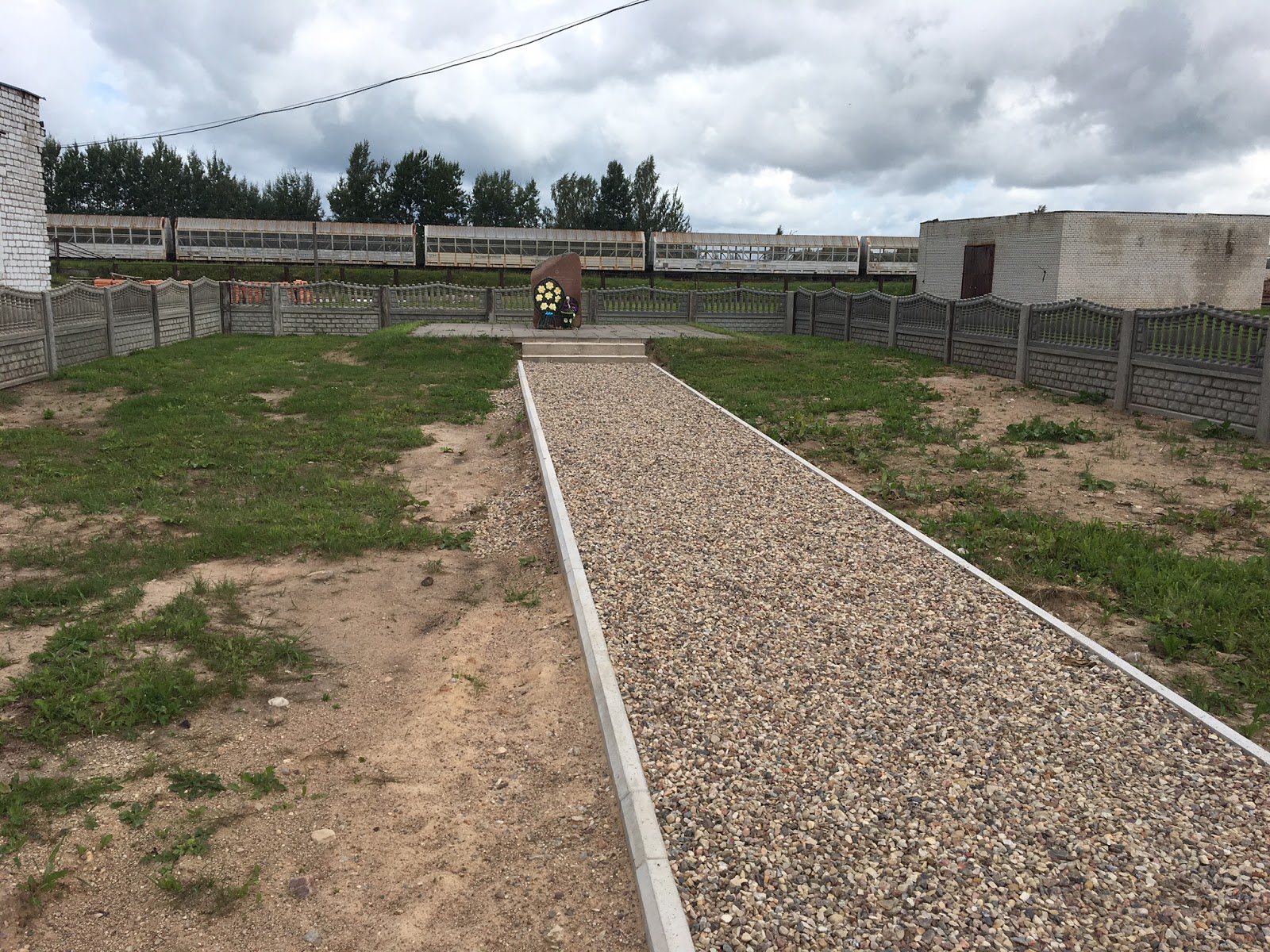
In 2004, Edna visited Parfyonova, Belarus, and with the help of a local resident, visited the holocaust site. She then raised money to erect a monument. I’ve seen the monument many times, and am glad that she took the initiative to memorialize it; this is a mitzvah that should not be left to a stranger if at all possible.  I had believed the monument was erected by strangers, and was glad to be mistaken.
When I prepared a slide show for Edna, I reviewed correspondence with Pavel Yurmashev, a Belarusian who has been helping to beautify the site. I met Pavel in June at a reunion of the Bolash family in Parfyanovo. After making the holocaust site visible from the street by moving a fence, he planned some landscaping and the addition of a bench in the Fall. The idea for the bench came from Rabbi Marc Mandel. When I wrote that I was coming in September, 2019, he accelerated the plans to this summer.

monumnet dedication 2005
Shabbat Shalom from Newport and Jerusalem!
monumnet dedication 2005

Thank you to Rabbis Mandel and Kleiner for sharing their words, and to Beth Ginsburg Levine for editing.


monument site 2018