Thursday, February 14, 2019

Rabbi Mandel goes to the super bowl

Rabbi Mandel goes to the super bowl
at Touro Synagogue
February 2, 2019

Edited by Beth Ginsburg Levine

ALSO ON FACEBOOK


It’s that time again. Super Bowl Sunday is approaching,  if you like to shop, it’s a good day. Many people will be preoccupied .

Is there a lesson that the New England Patriots can teach us?

On Shabbat, Rabbi Marc Mandel of Newport’s Touro Synagogue expounded,

“Tomorrow is the big game. Once again, the Patriots are in the Super Bowl. How do the Patriots make the Super Bowl so many times? Coach Belichick says that the reason is because every person on the team plays a role. They have great teamwork.

“If you look at the Torah, in the book of Genesis there was no teamwork. It was each person for himself. It was Adam vs Eve, Cain vs Abel, Sarah vs Hagar, Jacob vs Esau and Joseph against his brothers. But as soon as Exodus began, so did the teamwork. Miriam watches her brother Moses in the water and Aaron helps his younger brother lead the nation.

“Let us learn from the Torah and the Patriots that the secret to success is teamwork.”

When I was in Egypt admiring the pyramids, which were already a tourist attraction when the Children of Israel were there, I wondered how they were built. Some of my acquaintances can’t believe that the “primitive” ancient Egyptians could manage it, and infer that a visitor from outer space was involved. They may be under the impression that our technology means that we are smarter.

I stumbled on a video by Bettany Hughes with the answer. https://youtu.be/f5JRJhmrOx4

Although the Egyptians didn’t have high tech there was plenty of labor at hand. The flooding of the Nile meant farm workers had almost six months a year available. It was a win win. They could make a little money and help ensure Pharaoh’s and Egypt’s second life.

The workers lived in a city built for them.  The work was very organized. The largest pyramid consisted of one million blocks. The blocks were quarried near the site of the pyramid. They were hauled on sleds by gangs of 20 workers, up a ramp as the pyramid got higher.  Each stone was finished after it was placed in its position.

In the drawings from ancient Egypt, as the blocks are being pulled, a man is shown pouring water on the sandy surface. Recent studies have shown that if the right amount of water is in the sand, about 5%, the amount of friction is reduced by almost half, meaning that fewer people can do the same work.

The work was dangerous. If a block slipped ahead of you, death or severe injury would result. The foremen got everyone to work a little harder by offering extra beer to the group that was the most productive. Ancient Egyptians and football fans will go the extra mile for a six pack.

Go Patriots!

May your sand and beer each have the optimum percentage of the appropriate liquid. And may each of you have the right amount of ruach (spirit) to be at the top of your game.

Shabbat Shalom from Shlomi, Israel


Friday, February 1, 2019

Is anybody listening?

Is anybody listening?
at Touro Synagogue
January 26, 2019

Edited by Beth Ginsburg Levine
ALSO ON FACEBOOK


We have a natural tendency to tune out. It helps us move on, but might make us less likely to listen to other people’s problems. And if we don’t listen, we don’t do. On Shabbat, Rabbi Marc Mandel of Touro Synagogue, Newport, spoke about listening.


“This week, many people heard about the National Grid crisis in Newport, and this reminded me about the Parsha. In this week's parsha, Yitro, Moshe’s father in law, joined the Jewish people when he heard about the miracles that happened to the Jewish people.


“What exactly did Yitro hear that made him leave his home and join the Jewish nation? Was it the exodus from Egypt? Was it the 10 plagues? Or the splitting of the Red Sea? Or the manna from heaven? When Yitro heard one of these things, he was inspired to join the Jewish people.


“What do we hear in our lives? We hear so many things in our lives, on our computers, our phones, our TV's, but what do we really listen to?


“I heard on the news this week that the current crisis with National Grid is the longest since Hurricane Sandy. I was thinking to myself, I don't remember being displaced by Hurricane Sandy like I was this week? The reason is, during Hurricane Sandy, my home still had oil heat, so I wasn't displaced. But I never paid attention to that crisis because it didn't affect me.


“Do we only hear things that affect us? Are we able to hear things that don't affect us? Let us learn from Yitro to hear about the lives of other people, and how we might help them. Shabbat Shalom”


During the parsha we learned that Gershom, son of Moshe and Tziporah, got his name because he was “a stranger in a strange land  (גֵּ֣ר הָיִ֔יתִי בְּאֶ֖רֶץ נָכְרִיָּֽה).”   ‘Ger’ means stranger, ‘shom’ means there. Tziporah means bird.


When Yitro brought his daughter and two sons to join their father, he heard how Moshe was running the ‘Children of Israel Show’. Yitro realized that Moshe was burning the candle at both ends, and advised him to share the responsibility. Moshe did so.


Stranger in a Strange Land is the title of a science fiction novel by Robert Heinlein, first published in 1961. Like much science fiction, it was a critique of current mores. When Heinlein was bed-bound with a bad back, he conceived of a waterbed, which he described in Stranger. It was actually an old idea…


Charles P. Hall came up with the key innovation that made the modern waterbed possible. In 1968, he was an industrial design student at San Francisco State University working on his graduate thesis, designing a comfortable piece of furniture. He consulted physicians so he could understand what made something comfortable.


After discarding a chair with a Jello-filled cushion, he started working on a bed. Hall had a eureka moment.  He placed the water in a vinyl bladder, with a heater to control the water temperature. The heater solved a problem; water is a good conductor, and pulls heat out of the body.  


When Hall couldn’t find a manufacturer he made the waterbeds himself. “We had a little shop in Sausalito, and we would deliver them on top of a Rambler station wagon,” he recalled. You know the song, "I lost my heart in Sausalito."


Hall considered the beds high quality furniture that solved a problem, but the beds attracted attention because customers thought the rolling motion enhanced sex. The sales pitch ran, “Two things are better on a waterbed, and one of them is sleeping.”


Hugh Hefner was an early purchaser. The waterbed was featured in a Playboy magazine article entitled “Bedsprings Eternal” about beds in May, 1970. Hall is still peddling the beds, at $2000 each. In Playboy fashion, the article was on topic, but the pictures were about the women who were posing on the beds.


Hall is smiling  because his invations have made him a
millionaire. photo: Seattle Times
Hall holds 40 patents, including one on the Sun Shower, an insulated solar heating bag used by campers to take a shower


Being in Egypt, I am a stranger in a strange land. I have listened to several guides. Often the guides are called Egyptologists. To me, that means an academic professional. But in the guide business, it is not clear what it means.


As I walk through the streets I listen as shop owners, taxi drivers, felucca captains, and caleche drivers look for business, often insistently.


Several people have unburdened their political opinions. Is it because they feel safer speaking to a foreigner? I nod and avoid reciprocating. When someone says, “Come in for tea,” are they looking for money?  When someone says, “Take my picture,” will they ask for baksheesh (a tip)? When they say, ”America is good,” I think, “Are we? How do they know?”


When I went for a walk the other day, I reached the Colossi of Memnon. These 3200 year old sixty foot high sculptures are from the mortuary temple of Pharaoh Amenhotep III, which was destroyed by an earthquake around 1200 BCE, shortly after it was built. The name refers to Memnon, a Trojan War hero, who was slain by Achilles.


The Colossi were a tourist attraction two thousand years ago because one of the statues whistled from 27 BCE-196 CE after an earthquake resulted in a crack. Several Roman emperors visited. Roman Emperor Septimius Severus may have repaired the crack in 199. Severus didn’t hear the whistle. Ninety reports by ancient visitors are inscribed on the statue, noting whether they heard the whistle.


Among the modern visitors was Peer Gynt from Norway, described in act IV of Peer Gynt, a play in verse by Henrik Ibsen. Ibsen asked Edvard Grieg to write incidental music. A reviewer didn’t like the poem. It was the last play that Ibsen wrote in verse. In 1968, with classmates from Rogers High School, I saw Providence’s Trinity Repertory Company’s production of Ibsen’s An Enemy of the People. I’ve been dazzled by the theater ever since. I learned that the majority is not always right, and have been slightly rebellious as a result. At the time, Trinity Rep and I were both young.


As I admired the sculptures from every possible angle, I met a Frenchman. When a motorcade approached, he informed me that the French consul had told him that former French President Valery Giscard D'estaing was visiting. I hurriedly waved and sang La Marseillaise. D'estaing waved back! He may not have heard me, but I know he was listening.


Shabbat Shalom from Jewish Newport! @trinityrep


Saturday, January 26, 2019

Sleeping on the Job

Sleeping on the Job
at Touro Synagogue
January 19, 2019

ALSO ON FACEBOOK


Newporters have been suffering during the coldest week of the year. On Monday, natural gas to Middletown and Newport customers was turned off after a valve failure led to a dangerous decrease in gas pressure. Before turning a re-pressurized system back on, the gas company needs to visit 7100 customers to turn the gas valves off in each home and business. About 10,000 people are affected. Otherwise, there is the chance of a slightest spark may cause an explosion and fire when the gas goes back on with pilot lights out. After the system is fixed, the gas company then needs to return to each customer to turn the gas valves back on. This might take more than a week.

Last week, Rabbi Mandel spoke about things that trouble us at night, “The Torah says, when the Jews were leaving Egypt at midnight, Pharaoh woke up. He was sleeping. How could the king of Egypt sleep when his country was falling apart? It is similar to Captain Ed Smith of the Titanic, who was sleeping the night the ship crashed into an iceberg. How could he sleep when there were iceberg warnings?
“Some people become too confident, or some people are too concerned about their own wellbeing. Sometimes, when our family has a crisis, I will wake up in the middle of the night and find my wife Jackie texting and trying to solve the problem. Apparently, I am guilty of this, too.


“King David says in the book of Psalms, I will wake up at midnight and praise God. The Talmud asks, how did David know when it was midnight? They answer, he would open his window and at midnight a breeze would activate his harp and wake him up. He had a wind chime. Let us try to be like King David and wake up to praise God and deal with life's pressing issues.”


We are fortunate at Congregation Jeshuat Israel that some of our members have stayed awake and worried about our hospitality.

In today’s Touro Update it was announced that CJl will have weekly Kiddish luncheons during the winter catered by Paula. Kol hakavod to the Touro members who brainstormed about making shabbat at Touro more delectable and welcoming, and to the CJI board for its enthusiastic response. I hope you will enjoy and support this initiative.

As I write this from my third floor apartment in Luxor, Egypt, I have help staying awake. Down below, a rooster sounds the alarm each morning at 4:15 AM, and also when the train goes by at 11:45 PM.

Ancient Egypt can be seen through two major types of buildings, temples and tombs, including the pyramids. Luxor is replete with tombs and mortuary temples for preparing mummies on the West Bank of the Nile, where I am staying, and with temples on the East Bank.

Both temples and tombs were painted, inside and out.

The temples proclaimed to ancient Egyptians that pharaoh was awake and on the job day and night, year in and year out, keeping them safe from external enemies, and assuring internal stability and adequate food. The message to neighboring countries was that Egypt was strong and would defend itself.

Pharaoh had both a human and a divine aspect, and is always pictured the same size as the gods.

Presenting Pharoah with the hands of the leaders
 of an enemy army.
Hunting scene. Notice the fish on lower right.
This was originally painted.
Battles scenes depict pharaoh leading the charge on a chariot, bow in hand. The defeated enemies are shown smaller than the Egyptians, and sometimes upside down. The leaders of the enemy army were killed, or their hands were chopped off. This was to impress the survivors, and get them to  agree to stay in Egypt and slave away on building projects rather than suffer the fate of their commanders.

The massive temples were dedicated to one or more gods. Some survived, roofs and all, because after they were abandoned they became covered with sand. They are found up and down the Nile.

I’ve had several guides, and each one brings a different perspective. I learned yesterday that the Egyptians believed there was a second life. They thought that this life was a brief part of their lives, and were willing to make major sacrifices to build their Pharaohs’ tombs, which were intended to smooth the way into the second life.

Since this life is short, not a lot of effort was expended on palaces. They were built from mud brick, which is easily damaged.

Mummified bodies were essential to enter the second life. The pyramids were riddled with passages that went nowhere to discourage grave robbers. This stratagem did not work so eventually tombs went underground.

The tombs contained fantastic amounts of treasure, purposely arranged so a grave robber would get to the gold first, and, hopefully, not disturb the sarcophagi with the mummies.

There was an interdependence between Pharaoh and the people who built his tomb. A pharaoh’s second life depended on the architects, foreman, craftsman and workers who spent years building the tombs, starting from the day a pharaoh started to rule until his death. The longer a pharaoh’s life lasted, the larger the tomb.

Painted ceiling. Only the wealthiest could afford the blue.
Other officials also had tombs. If there was not enough money to pay, plans were adjusted; the most expensive paints were not used, making things less colorful, and rather carve reliefs into the wall, the paint went right on the wall.

Mortuary Temple of Hatshepsut. It looks like its part of
themountain, but most of it is not. This was just for
making her mummy.
Most pharaohs were men. Hatshepsut was a prominent exception. After her husband, Thutmose II, died she was the co-regent along with her 11 year old stepson. She assumed the title of pharaoh and ruled for 21 years. Her stepson became leader of the army and became pharaoh Thutmose III after her death. Hatshepsut’s successful and prosperous reign enabled her to undertake building projects all over Egypt. Recent research indicates she died of cancer caused by a carcinogenic salve, which she may have applied because of a skin condition. Pharaohs, including Hatshepsut, are pictured wearing false beards. That was for official consumption, and does not mean that they were bearded.  

The Egyptians had faith in their ability to complete multi-year projects that required tens of thousands of workers, and a considerable amount of funds.

Egypt rose to empire status under several generals who became pharaohs, and extended its reach into Syria, and southwards into Nubia.

Eventually, Egypt weakened and became easy prey for Assyrians, Persians, and Greeks.  Alexander the Great took Egypt without having to fight for it. He and the Ptolemies who succeeded him respected Egyptian customs, and continued to build temples in the Egyptian style. The Romans followed the same policy.

May you be awake when you need to solve problems, and be warm enough to sleep in comfort when you are in need of rest!

Shabbat Shalom from Jewish Newport!


@jewishnewport @tourosynagoguenewport

Friday, January 11, 2019

Does the Sphinx have a tail?

Does the Sphinx have a tail?
at Touro Synagogue
January 5, 2019

ALSO ON FACEBOOK


Did you make any New Year's resolutions? Making them is easy, keeping them isn’t.


Rabbi Marc Mandel connected New Year resolutions to the parsha.


“Why did Pharaoh keep on changing his mind about letting the Jews go free? One day yes and one day no? He didn't really believe in the God of the Jews.


“We know this from the previous parsha [Shemot 5:2], ‘I don’t know God, and I don’t know Israel.’


“Pharaoh thought it was just a ploy by Moshe and Aaron to let the Jews leave Egypt and he wasn't about to lose all his slaves.


“Why can't we keep our New Year Resolutions? Why can't we stick to them? For the same reason, a lack of belief. This time, it is a lack of belief in ourselves. We don't really have faith in ourselves that we can make significant changes to our lives. We need to learn from Pharaoh to have faith-in ourselves!


“We can each do great things in our life’s journey if we have belief in ourselves.


”Shabbat Shalom.”


Speaking of journeys, the next morning at a Temple Israel Brotherhood of Sharon MA Shabbat breakfast I heard a talk at a Temple Israel Brotherhood of Sharon s by URI Professor Alan Verskin about a new book, ‘A Vision of Yemen: The Travels of a European Orientalist and His Native Guide, A Translation of Hayyim Habshush Travelogue.’ Just saying the title makes me lose my breath.


Hayyim Habshush accompanied Jewish French orientalist Joseph Halévy on a journey through Yemen. In the book, Habshush, a Yemenite Jew, described their 1869 travels through remote parts of Yemen. Halévy was the first European traveler to Yemen since the year 24!


One of the subjects Professor Visken spoke about was, “How should travelers react to things that they don’t like or think is wrong?”


Halévy and Habshsush  visited a remote village that is now in Saudi Arabia. The Jews had adopted local customs as their own. Their host family was in the process of finding relatives to kill a pregnant unmarried daughter. This upset the travelers, but the villagers were convinced this was a Jewish custom. She told the travelers that she was impregnated by a married relative, and that it was impossible to tell this to anyone.


Habshush made various proposals to solve the situation. He offered to pay for an abortion. The relieved family said okay but Halévy convinced him this was not permitted. He offered to marry the woman. The family questioned his sincerity, but agreed. Halévy intervened and pointed out that Habshsush was already married. At that point they continued their journey.


Should travelers intervene, or just observe?


That evening I went traveling myself: Destination: Cairo, Egypt.


Cairo is very polluted. The sky is hazy, and the air smells acrid.


I spent a day going from one pyramid to the next. They are on a large plateau not far from the center of Cairo. When the haze lifts the view is magnificent. The pyramids are in three areas on the plateau. I was able to find the answer to a question I have had for a long time. “Does the Sphinx have a tail?”


Many years ago the Newport Daily News syndicated a column where people could send a question and get an answer. I wrote my question about the Sphinx. Shortly thereafter, when I was about 7 years old, I was in the Newport Hospital for two weeks with a case of pneumonia.  In those days hospital stays were long, and when I felt better I started running around the ward and being a nuisance. When I got home I asked my parents if I had received a letter. They said yes, but did not think it was important, and threw it out.


I am now happy to report that the Sphinx does indeed have a tail, a rather large one, at that.


Another day was largely spent in Islamic Cairo. I visited a market that had been ongoing since 1187, and several mosques.


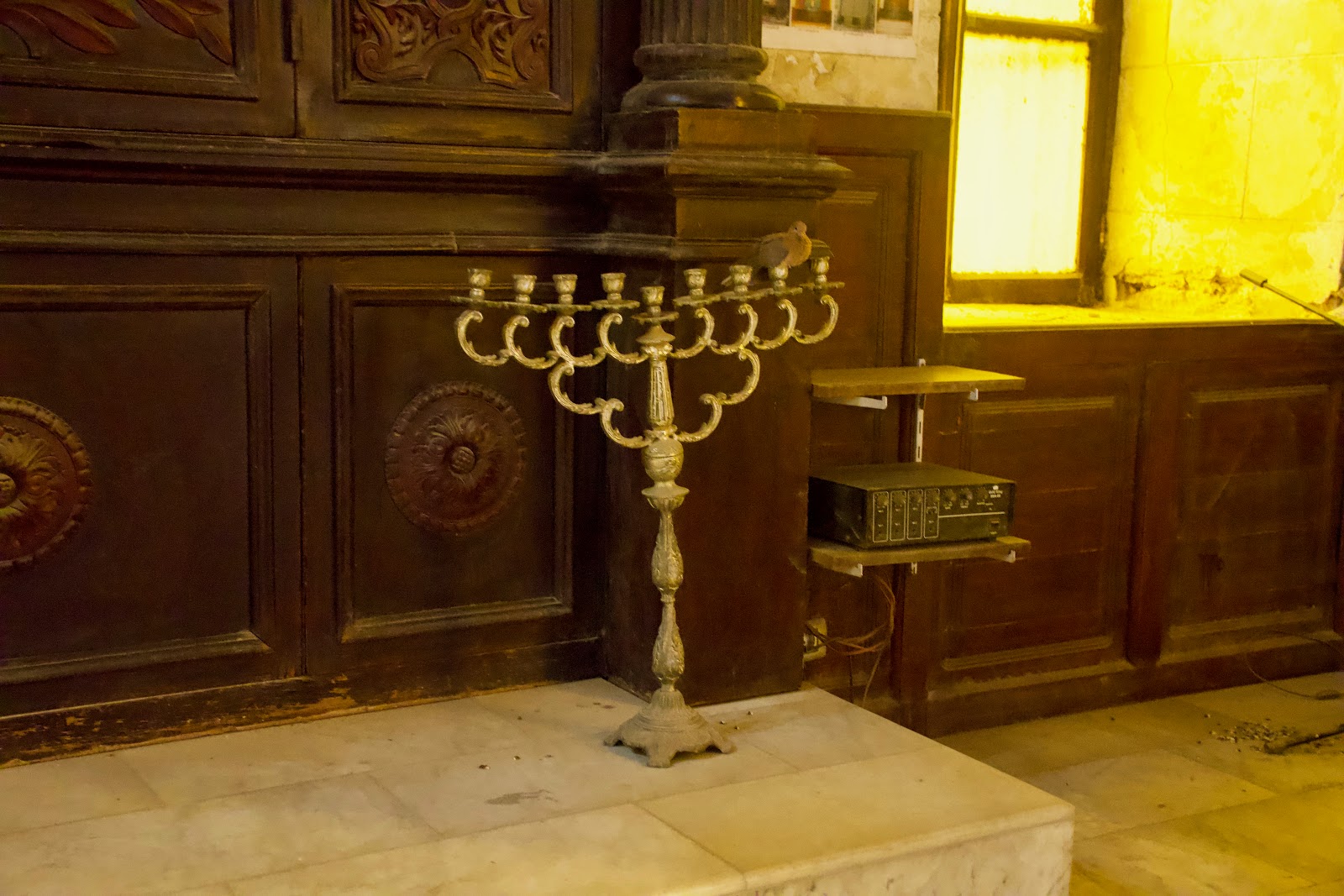
A highlight was a visit to the Maimonides Synagogue, which was built in the nineteenth century on the site of the synagogue that Maimonides attended. It was restored by the Egyptian government in 2010.


Shabbat Shalom and Happy Travels!


@TIbrotherhood @tourosynagoguenewport