Friday, August 3, 2018

À la recherche du temps perdu

À la recherche du temps perdu
At Jewish Newport
July 28, 2018


It was hot at Touro Synagogue, especially when the lights and fans went out. Rabbi Marc Mandel kept his sermon short.


“In the summer of 1852 the American poet, Henry Wadsworth Longfellow, brought his family from Cambridge, Mass to Newport for a vacation. Longfellow became entranced with Touro Synagogue’s cemetery up the street.


“He wrote a poem about it. Here are some short excerpts:


‘How strange it seems! These Hebrews in their graves,
Close by the street of this fair seaport town.


‘Closed are the portals of their Synagogue,
No Psalms of David now the silence break,
No Rabbi reads the ancient Decalogue
In the grand dialect the Prophets spake.


‘What once has been shall be no more
And the dead nations never rise again.’


“Today Longfellow was proven wrong. We did read the decalogue, the Ten Commandments. And we are not a dead nation. We’re here. We’re alive.


“If the Ten Commandments are so important, why aren't they part of our daily prayers?


“Well, that’s a trick question because the Talmud teaches us that they really are part of our prayers-they are incorporated into the Shema. The Shema and the Ten Commandments are very similar. And we read the Shema today too-the first paragraph.


“So this is one of the most important Torah readings of the year. Its also Shabbat Nachamu based on the Haftarah that Saul read. We pray for consolation. We pray for redemption-may we see it speedily in our time.


“Shabbat Shalom!”


Longfellow appeared to be very familiar with Judaism. His lack of sympathy might owe something to the times he lived in. America’s great future, which was believed to be a break with the past, was apparent. We Jews can boast of a great past, and do our best to make it part of our present. (Thanks to the Maine Historical Society for this insight.)


According to the Mishnah, during the Second Temple period the Ten Commandments were recited daily before the Shema. The Talmud explains that (Yerushalmi Berakhot, Chapter 1, fol. 3c), “It would be proper to read the Ten Commandments every day; and why don’t we? Because of the zeal of the heretics lest they say: These alone were given to Moses at Sinai.”


Over the years, our Rabbis have been concerned that we not elevate the Ten Commandments at the expense of observing the other commandments.


Rabbi David Golinkin reviewed this in ‘Whatever Happened to the Ten Commandments?’ His grandfather, Rabbi Mordechai Golinkin, was a Rabbi in Dokshitz, where many Newporters trace their roots, in the 1920s. His headstone in Worcester, Massachusetts, says he was the rabbi and Av Bet Din of Zhytomyr, Dokshitz, Danzig and Worcester, and was on the Vaad Harabonim of Massachusetts.
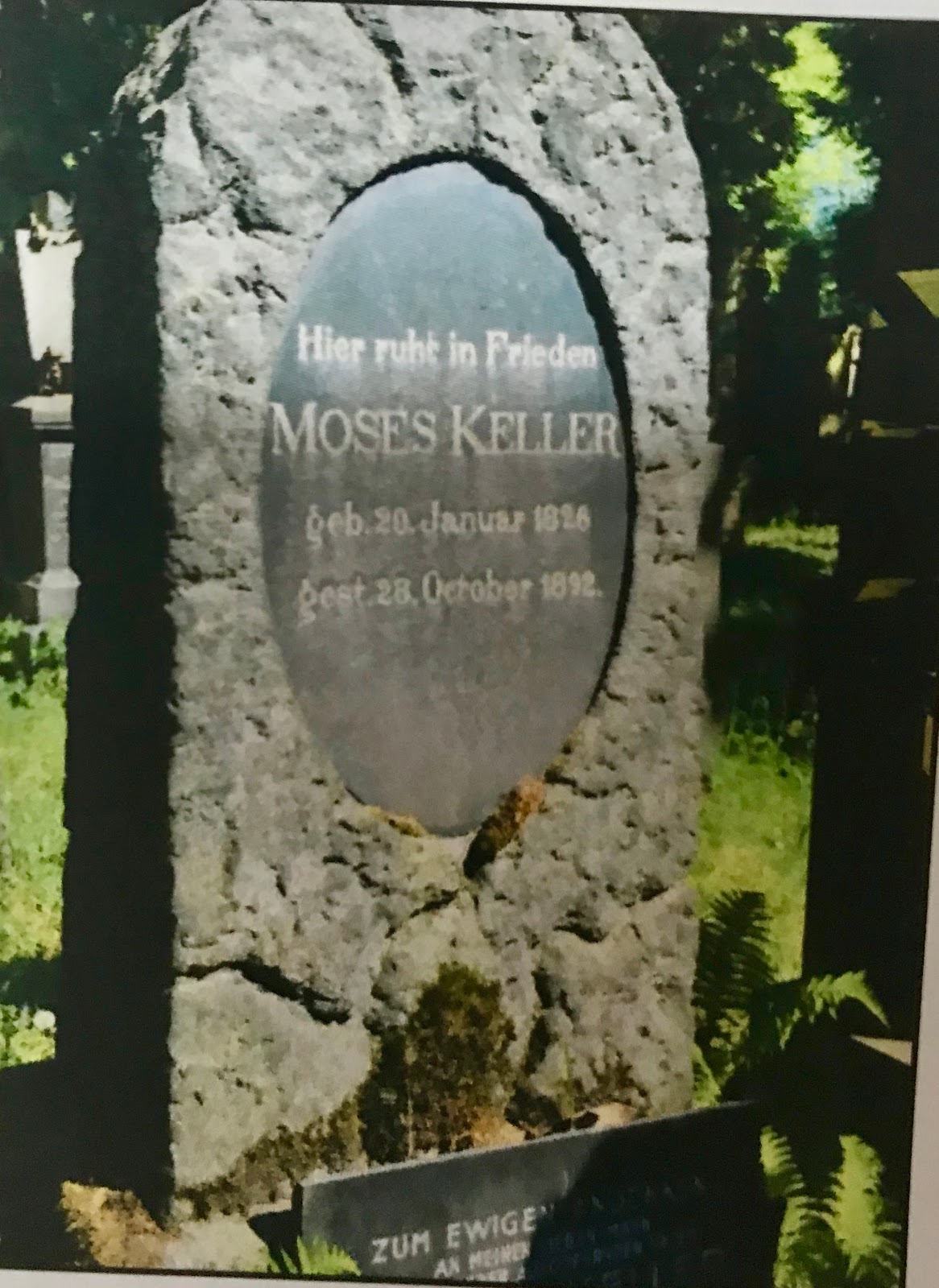

Ralph and Delia Klingbeil sponsored the Kiddish and spoke about their recent trip to Frankfurt and the Netherlands. The Klingbeil’s friend, Heidi Keller Moon, who also traces her routes to Jewish Frankfurt, accompanied them on the trip and joined us on Saturday.Ralph said, “This kiddish is dedicated to the chemical element lithium-atomic number 3 – for the 3 of us who journeyed together. Lithium is a soft, silvery-white alkali metal and it is the lightest metal and the lightest solid element. Like all alkali metals, lithium is highly reactive and flammable.”

At Frankfurt's Old Jewish Cemetery, Heidi visited the grave of her great grandfather, Moses Keller and a nearby memorial to a cousin of her of her father, who was murdered in Aushwitz.
The Philanthropin


Freida Steinhauer
Ralph’s mother, Freida Steinhauer Klingbeil, was born in Frankfurt. They were able to see some of the places associated with her life. She studied at The Philanthropin, a Jewish school founded in 1804 by Mayer Amschel Rothschild, as did Heidi Keller Moon's grandmother, Elsa Ruths. The building still stands, and is still a Jewish school!


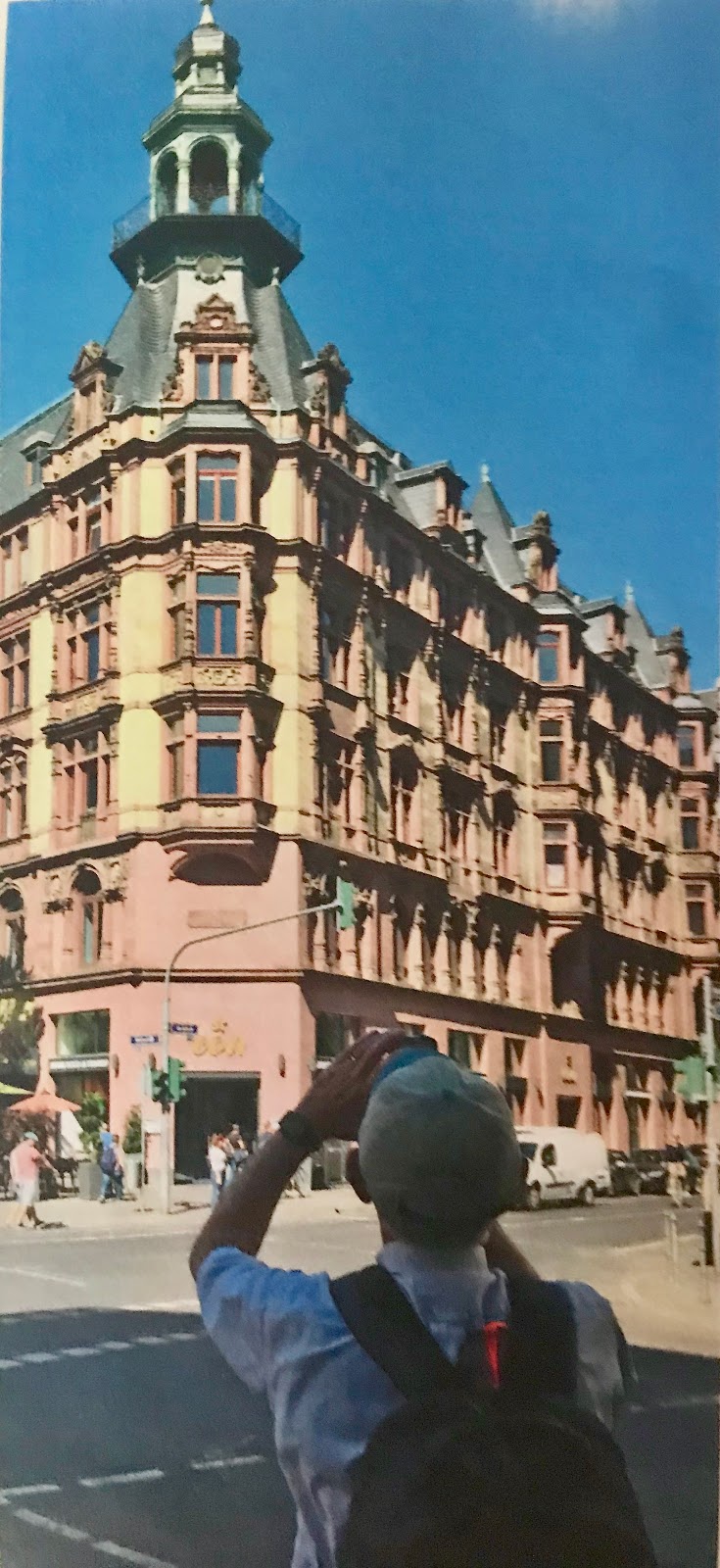
Kaiserstraße 68
Kaiserstraße 68 today
Ralph's mother worked for Karl Kahn, Kaiserstraße 68, and this building also still stands.


The Jewish cemeteries in Frankfurt, to Ralph’s surprise, were not destroyed, and Ralph was able to place a stone  from Mackerel Cove, Jamestown on the matzeva his grandfather, Louis Steinhauer, at the New Jewish Cemetery.


When they went to eat, Ralph saw the sign for the Struwwelpeter Restaurant. Ralph recalled, “I experienced an involuntary and stunning memory flash of Struwwelpeter from almost 70 years ago. Struwwelpeter is a perverse, sadistic book for 3 to 6 year old children, written in 1845. One story is about trying to make a boy, Conrad, stop sucking his thumbs. The tailor and his scissors solve that problem. I loved the book and from about years 3 to 4 we were inseparable.


Der Struwwelpeter is one of the first modern illustrated children’s books. It’s ten stories about the results of children’s misbehavior. It was written by Heinrich Hoffmann in 1845 when he couldn’t find a good book for his 3 year old son. It’s a precursor to comic books, and has been translated into many languages, including English by Mark Twain.
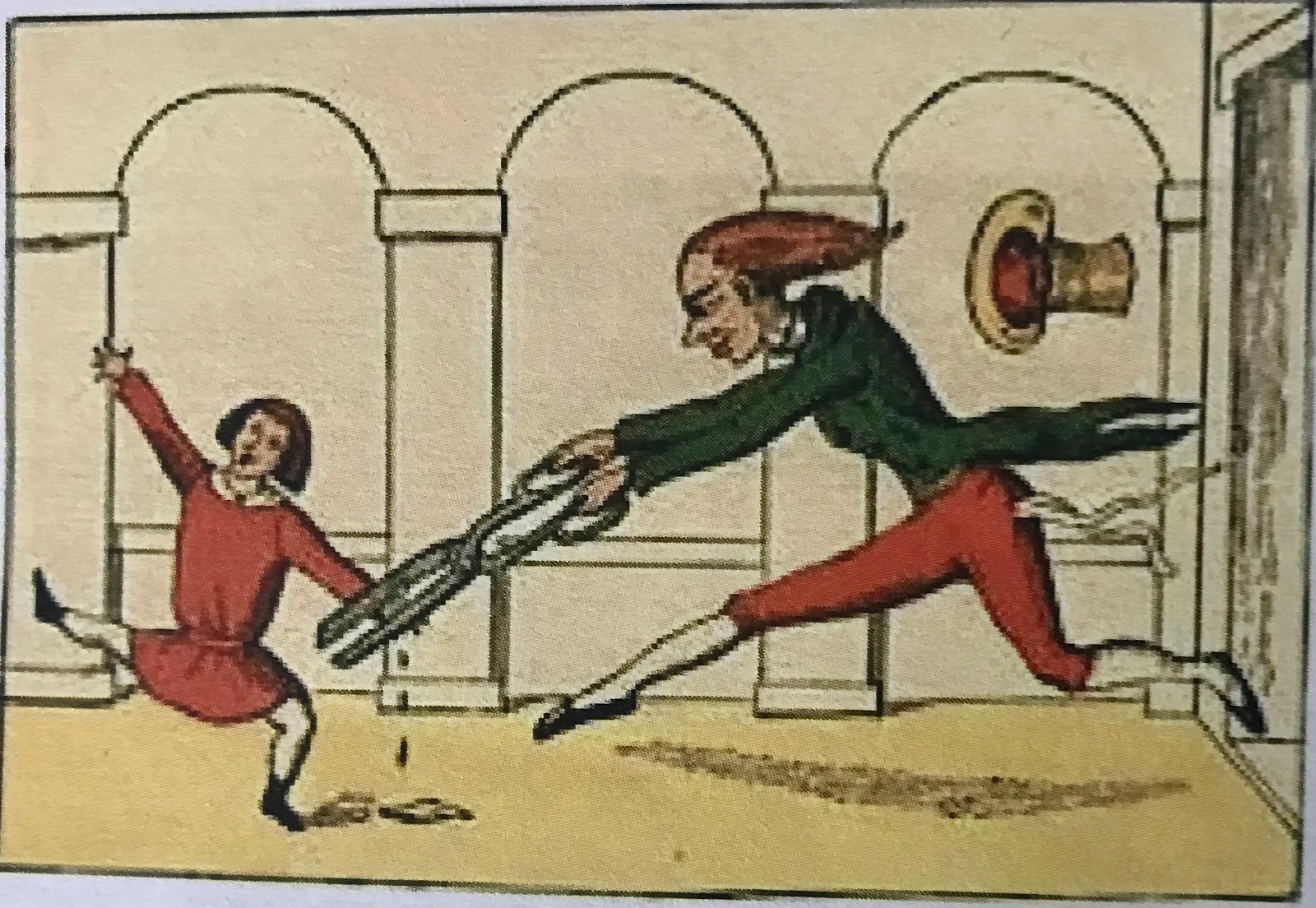
Heinrich Hoffman was born in Frankfurt, where he became a psychiatrist. According to Wikipedia, he was skeptical whether his treatment was helping his patients, and was also skeptical about ideology, and was against religious, philosophical and political bigotry.

Seeing the name of the restaurant and pictures on the walls of the book was enough to bring the childhood memory to Ralph’s mind.

This is called an involuntary memory. The phrase was coined by Marcel Proust in his novel À la recherche du temps perdu (In Search of Lost Time). In the book, the protagonist recalled a memory after being served madeleines, a pastry.

“And as soon as I had recognized the taste of the piece of madeleine soaked in her decoction of lime-blossom which my aunt used to give me (although I did not yet know and must long postpone the discovery of why this memory made me so happy) immediately the old grey house upon the street, where her room was, rose up like a stage set to attach itself to the little pavilion opening on to the garden which had been built out behind it for my parents (the isolated segment which until that moment had been all that I could see); and with the house the town, from morning to night and in all weathers, the Square where I used to be sent before lunch, the streets along which I used to run errands, the country roads we took when it was fine (Proust, 1928).”

The novel, which began to be published in 1913, took the world by storm, with it’s 3200 pages and 2000 characters. It was the first work to use stream of consciousness.

Ralph's grandparents,
Johanna & Louis
Steinhauer ca 1914
Louis  & Johanna
Steinhauer 

One of the memories we hold dear is that we were present at Sinai. This is so ingrained in our consciousness that it has become an involuntary memory, one that we can recall when we need to, for example, at a Passover seder. Rather than Proust's pastry, we stimulate our memories with matzah, moror and karpas.

Shabbat Shalom from Jewish Newport
The Steinhauer Family


Friday, July 20, 2018

Is there a doctor in the house?

Is there a doctor in the house?
At Jewish Newport 
July 14, 2018


Today I had a special role. I was designated to ask Mike to get some water for Rabbi Marc Mandel, which I delivered. It was a double parsha, and his voice was reaching its limit.

I remember being sick one day when I was growing up in Newport. My parents, Maurice and Dorothy Ginsburg, went to work at the family grocery store, the Broadway Market. My sisters went to school. I was put on the wonderful couch in the living room, opposite the picture window, by far the nicest room in the house. Not long afterwards Dr. Lewis Abramson came by to make a house call. I loved the attention. It was around the time we had to line up in front of Dr. Abramson’s office on Broadway for immunizations.

In kindergarten and first grade I was friendly with Buddy Ritchie. His mother owned Broadway Florist. They lived nearby on Wilbur Rd. Buddy and I clambered up their low garage roof. I slipped and fell on to my back.  I was a little winded. Buddy said, “I forgot to tell you about the slippery shingle.”  We went into the house.  Mrs. Ritchie put me in a laundry basket on top of the just folded clothes, right next to the basket of young puppies. She called my mother, who called Dr Abramson. He instructed her to take me to the Newport hospital for an x-ray. I received a back brace, which I wore obsessively for the next few months.

Today at Touro we were joined by several doctors who were attending the 18TH ANNUAL THOMAS JEFFERSON UNIVERSITY SPINE FELLOWS ALUMNI SYMPOSIUM. This has been in Newport for many years, and some of its physicians have formed a strong attachment to Touro Synagogue. With their families Drs Lewin, Hillebrand, Reich, Baron, and Kay sponsored the Kiddish Luncheon.

Rabbi Marc Mandel greeted everyone and continued,

“Where would our world be without doctors or without medicine? Our lives would not be what they are today without these excellent doctors and without the advances in medicine that they create daily. Look at those boys that were in the cave. Without the medicine and the food they would have died. And as soon as they were rescued – they were sent to the hospital for urgent medical attention. Much of the technology used in the cave rescue was from Israel.

“Today we finished reading the book of Bamidbar and we said, ‘Hazak, hazak, Vnithazek’ be strong, be strong and be strengthened.

“The talmud says there are several things that need to be strengthened. One of them is Dereh Eretz. Dereh Eretz refers to anything that improves this world. To make anything that leads to a better society. Medicine is improving so rapidly – and it is making our lives so much better. Without these advances in medicine we’d be in deep trouble.

“The Jewish people have always understood this and that’s why many of the great doctors throughout history were Jews. Think about the Rambam, Maimonides, who was the king’s physician in Egypt 1000 years ago. And think to our own day with the Salk vaccine from Jonah Salk which eradicated polio. Hazak hazak. Doctors need our unconditional support – in their work to improve  this world.

“Recently there was a guest here in Newport who I hadn’t seen in a while. He said, 'I came to Newport to recover from an ordeal.' He had a new kidney donated by his son. What an amazing medical breakthrough, kidney transplants. He’s fine now and so is his son. Doctors need chizuk, they need our support. 

“Each year Jeanie and Jay sponsor the Schottenstein prize in cardiovascular sciences and medicine: it’s a prize that goes to a physician who has was excelled in medicine – and it’s a very generous prize that’s chizuk that strengthens medicine. The most recent recipient was Dr. Helen Hobbs from Texas, who has done outstanding heart research in Dallas.

“This  week I received an email from the Puah Institute, which is an organization that deals with medical fertility issues. They asked, 'Why does the Torah have to list each place the Jews traveled? Why is that so important?'

“The journey is not always easy. There can be delays, challenging weather, and personal issues to deal with – but if a parent has a child that’s not well, they will make any journey that is necessary for their children, just as Hashem is with us in our life‘s journey.

“So we thank all of the spine surgeons who made the journey to Newport this week – and we think all the physicians in this room for their outstanding work – we thank Jeanie and Jay for giving chizuk(strength) to the medical world – and may each of us have the strength to improve this world, each in our way. There  are many great professions in the world- we each have a role to play.

“Shabbat Sholom!”

At the kiddish, Dr. Jonathan Lewin, of The Center for Musculoskeletal Disorders in Englewood, New Jersey, spoke briefly. He complemented Rabbi Mandel for reading the double parsha, and said it would have taken him two months to prepare it. He also thanked CJI for its hospitality.


Shabbat Sholom from Jewish Newport.

Friday, July 13, 2018

Butterflies Are More Fun


Butterflies Are More Fun

At Touro Synagogue
July 7, 2018

On Shabbat seventy-five congregants and visitors heard Touro Synagogue’s Rabbi Marc Mandel speak about people who make a difference. 

After welcoming everyone, the Rabbi gave shoutouts to Jeannie and Jay Schottenstein for their “extraordinary dedication to the well-being of the Jewish people all over the world and in the US and Israel where so many great projects are undertaken thanks to your philanthropy and commitment,” and for their “concern and care to make sure our Shul continues to serve as a vibrant community dedicated to sharing its history with everyone,”

And to Paul Glasser, vice-president of Touro College, which has campuses all over the globe. Paul Glasser has been serving as a leader in the Jewish community for decades, and to Milton and Doryne Davis, leaders in Englewood, New Jersey.

Milton Davis’s father was a Holocaust survivor from Munkács, Hungary, now Mukachevo, Ukraine. During WW II, eighty-five percent of the Munkács Jewish community was murdered, most in Auschwitz.

I visited Munkács in June. Munkács nestles in the Carpathian Mountains. Before WWII the population was over 40% Jewish. Now it is a lively Ukrainian town, but signs of the past exist. There is a very small Jewish community.

The Jewish cemetery was marked for destruction during the Soviet era; the matzevot (headstones) were buried in four pits. Public pressure prevented the final destruction. Thousands of flat stones cover the grave sites. (If it does not appear,a video slide show is at https://youtu.be/88f5tJPiaMI)

Monuments have been assembled from matzevot that have been retrieved from the pits. Relatives moved a few of the graves and matzevot to a new cemetery. Both cemeteries are fenced and cared for. The caretaker made sure that we washed our hands on leaving the cemetery.

Does what we do make a difference? If not, what is the meaning of life?  These are questions that keep some of us awake at night.

In The Vocation of Man (1800), Johann Gottlieb Fichte states, "You could not remove a single grain of sand from its place without thereby ... changing something throughout all parts of the immeasurable whole".

To Sir Isaac Newton, it was the three body problem. For Newton, that meant predicting, with mathematical certainty, the positions of the sun, moon and earth at any particular time.

In Einstein’s theory of relativity, the three bodies are any three objects, but since time changes, it becomes a fourth object.

Science fiction writers know a good thing when they see it. Time travel is often used to show how a small alteration in the past leads to a different future. In 1952 Ray Bradbury wrote a short story,  'A Sound of Thunder,' about a hunt that traveled 55 million years back in time to slay a dinosaur. The hunter had a melt down, crushed a butterfly with his boot, and the future changed. If you are a Trekkie, you know what I am taking about. Think timeline and temporal wars.

In 1961, MIT mathematician and meteorologist Edward Norton Lorenz pioneered chaos theory after he realized that the predictions of meteorological models were not always accurate, and that small changes in initial conditions could lead to vastly different outcomes. 

Lorenz described it in terms of one flap of a seagull’s wings causing a hurricane. His colleagues told him, 'Butterflies are more fun.' When Lorenz wrote an untitled paper, a colleague, Dr. Philip Merilees, pounced. The title became, 'Does the flap of a butterfly’s wings in Brazil set off a tornado in Texas?' and the “butterfly effect” was launched. 

I asked Newporter Mrs. Namel Chadash if she could make sense of this. She did not disappoint.

“So, Reb Ginsburg, vas is all dis meshugaas? Do you really think people are interested in Newton, Fichte, and butterflies? Genug already!

“Let me explain you the three body problem. When I told my three kindele, Beth, Judy, and Aaron, to sit still, they never listened. Vey iz mir, a few minutes later they were gone. Now that’s a three body problem! I solved it with a kick in the tuchas! 

“Professor Fichte-Geshichte, in Newport we know a thing or two about sand. If you walk on Easton’s beach, the only thing that will change is your feet, with those tiny grains of sand clinging. If that bothers you, just go to Island Park, and enjoy the rocks.  That’s da ganze geshichte!

“And as for you, Professor Lorenz, alvays you shouldn’t listen to your friends. Stick with seagulls. My Jonathan Livingston would never hurt a flea, just an occasional clam. When your feet are stuck in the sand at First Beach, just keep your eyes overhead. Since you have your head in the clouds, vat do they say, ‘No problem!’” 

Rabbi Mandel touched on all of this in his Torah talk, including the meaning of life, and the difference a person makes and should make.

“Individuals play an important role in the world. We see it in these last few Torah readings.

“In today’s Parsha, it’s Pincus who manages to calm things down in the Jewish camp. Last week it was Balak, who hired Balaam who created one of our most important tefillot, ‘Ma Tovu.’ 

“This week millions of people were focused on one individual-one person-I’m referring to LeBron James. Millions of people followed his decision to move to Los Angeles. 

“LeBron James, known as King James. No different than any other king. Well-known throughout the world. The power of one individual to influence the lives of millions of people. 

“You might say basketball is not that important. That misses the point. In today’s world of social media and the Internet everything is equal. King James is just as important as any other big news item and it’s all about one person. Of course this doesn’t last forever.

“.In this week’s pasha – the leader of the Jews, Moshe, Moses, tells God, 'I’m done. I can’t do it anymore. Please, find someone else.' Franz Kafka said, 'The meaning of life is that it stops.' A human being stops! The greatness of a person, the thoughts, the intelligence, the beauty, it all stops. 

“Our job is to utilize the energy and strength that we have  while we can, while we are strong, while our minds are sharp.

“Let us do like Moshe, Yehoshua, Miriam and the daughters of Zelophehad, who told Moshe,  'We want a share in the land of Israel, there are no boys in our family, just girls. We want a share…’ They showed their love for Israel and were  rewarded with a share.

“We have to learn from these women to show our dedication to Israel and not take it for granted. These are the lessons that we need to learn from this week’s great people. 

Shabbat Shalom!”

And Shabbat Shalom from Jewish Newport

@tourosynagoguenewport @newportri

Friday, June 29, 2018

The Test

At Touro Synagogue 
June 23, 2018
The Test
BLOG   FACEBOOK 

It was nice to return home after a long hiatus. During my last visit, on April 28, Rabbi Marc Mandel mentioned a newspaper story. “A Jew in Germany told a gentile friend that it was dangerous to wear a kippah in Germany. The friend, an Israeli-Arab tried to prove that this was not true. The test ended badly and the friend was beaten up.” 

I was about to leave for a trip to Europe including Greece, Poland, Ukraine and Belarus. “I asked the Rabbi, ‘Are you suggesting I should wear a kippa during my trip.’ He demurred, ‘That’s not necessary. The test has already been performed.’ “ 

Being contrary, I decided to wear a kippa during the entire trip.  As I previously related, the first person to approach me was an Israeli visitor to Thessaloniki (Salonica), Greece. He told me when services would take place at the local synagogue. We stumbled along in Hebrew until I ran out of breath, and blurted out that I was an American. Subsequently a Jew who lived in Salonica also said hello.  

Every so often someone would say Shalom to me.

In Warsaw, I walked into the Old Town neighborhood with my friend Alan Kaul of Sharon, Massachusetts. Warsaw was almost entirely destroyed during World War Two and most buildings are recreations. As we entered the neighborhood, a short street was lined with six police cars full of police. 


Around the corner we walked into a plaza with 500-1000 boisterous people. On the horizon  was a large stadium with a soccer match. A young man yelled at me, “Juden Raus!”  (Jews Out!) “Really?”, I asked.  The response came quickly, in English, “Yes!”


Alan and I walked in the opposite direction. As we sat down in a nearby restaurant, visiting Israelis at the next table hastened to unburden themselves. They told us about the incident, unaware that I was the protagonist. 
0

In today’s parsha, Moses was the protagonist. He was tested at the Hard Rock Cafe. The test did not go well. Our Rabbonim have had a difficult time explaining Moses's error. Following their reasoning is a test in itself. This week, Rabbi Marc Mandel gave it a try. 

“This week’s Torah reading, Parshat Hukat, is one of the saddest Torah readings of the year. In today’s Torah reading, Miriam dies, Aharon dies, and Moses is told that he would never enter Israel, because of his sin with the rock, when he struck the rock instead of speaking to the rock for water: Moshe’s whole family-wiped out in today’s reading. What exactly did Moshe do wrong? No one speaks to a rock? And in the book of Exodus, Moshe was told to strike the rock?

“There a sin of commission and there a sin of omission. According to Rabbi Ari Kahn from Bar Ilan University, Moshe committed a sin of omission. Rabbi Kahn quotes the Netziv [Rabbi Naftali Zvi Yehuda Berlin was born in Mir and died in Warsaw. Leading the Volozhin Yeshiva, he shut down the school after onerous pressure from the Russian government in the 1890s.], who says Moshe never taught the people how to pray. He never taught them how to daven. This is a problem that still exists today. 

One of the biggest challenges that day schools face today is davening. The students don’t like to daven. They tune out during davening. It’s a big challenge that day schools face. But davening is a challenge for adults too.

“Years ago, I lived in Manhattan on the West Side, and I attended The Lincoln Square Synagogue. Rabbi Ephraim Buchwald led a service called the “learning minyan” or the beginners minyan. People learned how to daven. I used to attend this service because I wanted to see how to talk teach davening. Several years later I was hired by shul in Manhattan on the East Side, KJ, Kehilath Jeshurun, to conduct the learning minyan. It was a learning experience because I was tasked with the challenge of teaching people how to daven. 

“Hopefully here at Touro, we can all learn how to daven better, with more kavanah, more concentration, and more understanding of our tefilot. This way we will be able to learn to mysterious lesson of this week’s parsha. 

“Shabbat Shalom!”

Hukat was a short parsha. There was plenty of time for davening and for understanding, and for thinking about the next post for Jewish Newport!
@tourosynagoguenewport